

With the digital transformation taking healthcare to new horizons, government organizations throughout the nation are embracing technology for a better and efficient approach toward their citizens, with increased transparency and efficiency of patients. As part of the transformation of digital technology in the Indian health industry, there is labsys.health.gov.in, which is a web-based laboratory information management system portal used by the Government’s Healthcare establishments. The digital lab management software, through labsys.health.gov.in manages patients and patient samples; laboratory tests and reporting; records management of the laboratory and more through this centralised system.
This makes work hassle free with the help of abyss online platform where instead of using pen and paper methods for everything; one can have digital work done at speed and with accuracy, better patient information management.
This post serves as the ultimate guide for anyone, whether as healthcare professional, technician, hospital administrator or merely someone trying to understand about labsys.health.gov.in.
Table of Contents
What is labsys.health.gov.in?
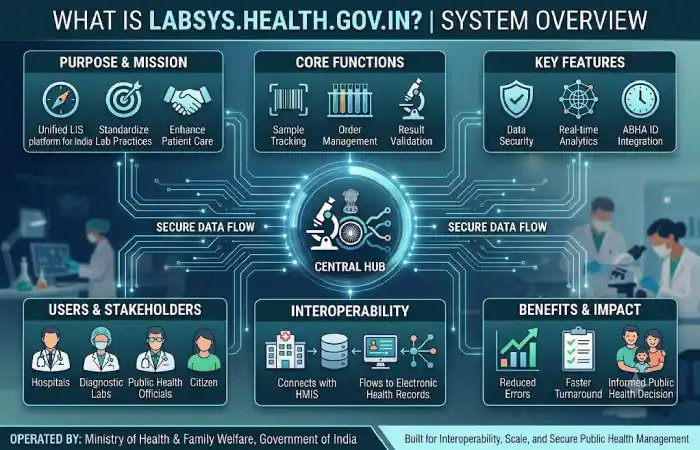
labsys.health.gov.in is a government-operated Laboratory Information Management System (LIMS) designed to digitize laboratory operations within public healthcare institutions in India.
The platform enables authorized laboratories to manage every stage of laboratory testing digitally, including:
- Patient registration
- Sample collection
- Barcode generation
- Sample tracking
- Test allocation
- Laboratory processing
- Result verification
- Report generation
- Digital record management
Laboratories can instead electronically securely save and read out data about patients instead of having physical documents registers The platform allows better faster collaboration between hospitals, laboratories and healthcare professional while minimizing the paperwork.
Why Was labsys.health.gov.in Developed?
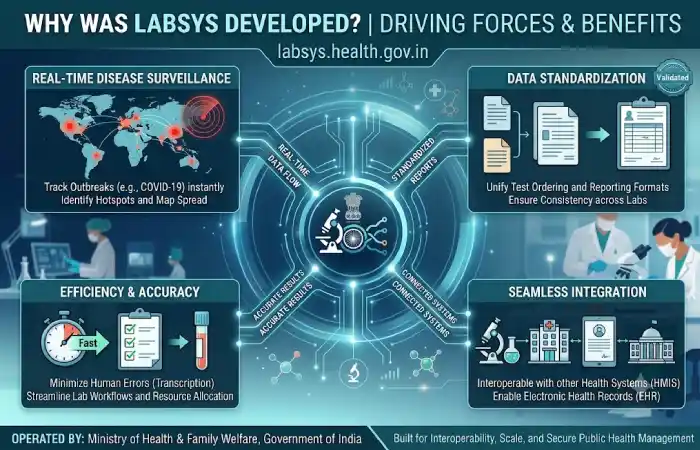
Thousands of laboratory tests are performed at public hospitals on a daily basis. In manual systems managing this quantity of work presents several problems like:
- Lost paperwork
- Delayed reports
- Duplicate records
- Human errors
- Difficult record retrieval
- Inefficient communication between departments
To address these issues, the Government of India introduced digital laboratory management systems that standardize laboratory workflows.
The primary objective is to improve efficiency while ensuring that laboratory services remain accurate, transparent, and accessible.
Objectives of labsys.health.gov.in
The portal has several important objectives.
1. Digital Laboratory Management
The system replaces paper-based documentation with digital records.
This improves:
- Speed
- Accuracy
- Data consistency
- Long-term storage
2. Improve Sample Tracking
Every laboratory sample passes through multiple stages.
The portal helps monitor:
- Sample collection
- Transportation
- Laboratory receipt
- Testing
- Validation
- Report release
This minimizes the possibility of misplaced samples.
3. Reduce Manual Errors
Manual data entry often causes:
- Incorrect patient details
- Duplicate reports
- Missing test requests
- Wrong sample identification
Digital workflows significantly reduce these issues.
4. Faster Report Generation
Once laboratory testing is complete, reports can be reviewed, approved, and published digitally.
This shortens turnaround time for healthcare providers and patients.
5. Better Healthcare Management
Digital laboratory data helps administrators analyze:
- Number of daily tests
- Disease trends
- Laboratory workload
- Equipment utilization
- Resource planning
Such insights support better healthcare decision-making.
How labsys.health.gov.in Works
The portal follows a structured workflow from patient registration to report delivery.
Step 1: Patient Registration
A patient’s information is entered into the system.
Typical information includes:
- Name
- Age
- Gender
- Hospital ID
- Department
- Test request
Step 2: Test Request
The treating doctor requests one or more laboratory investigations.
Examples include:
- Blood tests
- Urine analysis
- Biochemistry
- Microbiology
- Haematology
- Serology
Step 3: Sample Collection
Laboratory staff collect the required specimen.
The system records:
- Collection date
- Collection time
- Collector details
- Sample type
Barcode labels may also be generated to improve identification and tracking.
Step 4: Sample Processing
After collection, the sample is assigned to the appropriate laboratory department.
Technicians process the sample according to standard laboratory protocols.
Each processing stage is recorded digitally.
Step 5: Result Entry
After analysis, laboratory personnel enter test results into the system.
Depending on the laboratory setup, results may also be imported automatically from compatible laboratory analyzers, reducing manual entry.
Step 6: Verification
Before a report is released, an authorized laboratory professional reviews and verifies the findings.
This verification process helps maintain accuracy and quality.
Step 7: Report Generation
Once approved, the final laboratory report is generated digitally.
Authorized users can access or print reports as needed, improving efficiency and record management.
Key Features of labsys.health.gov.in
The portal offers numerous features that support day-to-day laboratory operations.
Centralized Laboratory Database
All laboratory information is stored in one secure digital system, making records easier to manage and retrieve.
Digital Patient Records
Patient laboratory history can be accessed quickly by authorized users, supporting continuity of care.
Barcode-Based Sample Management
Barcode labels help identify and track specimens throughout the testing process, reducing the risk of sample mix-ups.
Test Workflow Monitoring
Each stage—from sample collection to report approval—can be tracked within the system.
Report Management
The platform allows authorized users to generate, review, print, and archive laboratory reports electronically.
User Access Control
Different users receive permissions based on their roles, ensuring that only authorized personnel can access sensitive information.
Audit Trail
The system maintains logs of user actions, helping administrators monitor activity and support accountability.
User Roles in labsys.health.gov.in
The labsys.health.gov.in platform supports multiple types of authorized users. Each user is assigned role-based permissions so they can access only the functions required for their responsibilities. This improves both efficiency and data security.
1. Laboratory Technicians
Laboratory technicians are responsible for the day-to-day handling of patient samples. Their tasks may include:
- Registering samples
- Printing barcode labels
- Recording sample collection details
- Updating test status
- Entering laboratory findings
- Managing pending samples
The system enables technicians to monitor workloads and reduce manual documentation.
2. Laboratory Scientists
Laboratory scientists perform detailed analysis of collected specimens. Depending on the laboratory department, they may work in:
- Clinical Biochemistry
- Hematology
- Microbiology
- Pathology
- Immunology
- Molecular Diagnostics
The portal helps them record observations, review quality checks, and submit results for verification.
3. Pathologists and Senior Medical Officers
Senior laboratory professionals review test findings before reports are released.
Their responsibilities include:
- Verifying laboratory results
- Approving final reports
- Reviewing abnormal values
- Ensuring quality standards are maintained
- Authorizing digital reports
This approval process helps minimize reporting errors.
4. Hospital Administrators
Hospital administrators use the platform for operational management rather than laboratory testing.
They may monitor:
- Daily testing volume
- Department performance
- Laboratory workload
- Resource utilization
- Report turnaround times
- Equipment usage
Such information supports better planning and resource allocation.
5. System Administrators
System administrators manage the technical aspects of the portal.
Their duties include:
- Creating user accounts
- Assigning permissions
- Resetting passwords
- Monitoring system performance
- Managing user roles
- Maintaining security settings
Only authorized personnel have access to these administrative functions.
Complete Laboratory Workflow
Major plus point for labsys.health.gov.in is its systematic digital workflow, it makes a lab more reliable and ensures its records are always traceable.
Step 1: Doctor Orders a Laboratory Test
Provider assess the patient and order some test for lab investigation.
These may include:
- Complete Blood Count (CBC)
- Blood Sugar
- Liver Function Test
- Kidney Function Test
- Lipid Profile
- Urine Examination
- Culture and Sensitivity
- Thyroid Function Tests
The request is entered into the hospital’s workflow for processing.
Step 2: Patient Registration
The patient’s information is recorded, including:
- Name
- Age
- Gender
- Hospital registration number
- Department
- Treating physician
- Requested investigations
This information becomes part of the patient’s digital laboratory record.
Step 3: Sample Collection
Depending on the required investigation, laboratory staff collect the appropriate specimen.
Examples include:
- Blood
- Urine
- Stool
- Saliva
- Sputum
- Tissue samples
- Swabs
The system records the date, time, sample type, and collection details.
Step 4: Barcode Generation
Each specimen receives a unique barcode.
The barcode enables:
- Accurate sample identification
- Faster scanning
- Reduced labeling errors
- Easier tracking throughout the testing process
Step 5: Laboratory Processing
Samples are routed to the relevant laboratory section.
Typical departments include:
Clinical Biochemistry
Performs tests related to:
- Blood glucose
- Cholesterol
- Electrolytes
- Kidney function
- Liver enzymes
Hematology
Handles:
- CBC
- Hemoglobin
- Platelet counts
- ESR
- Blood smear examinations
Microbiology
Conducts:
- Culture tests
- Antibiotic sensitivity testing
- Bacterial identification
- Fungal investigations
Pathology
Processes:
- Histopathology
- Cytology
- Tissue examinations
- Biopsy analysis
Immunology
Performs:
- Antibody tests
- Autoimmune investigations
- Allergy testing
- Specialized immunological assays
Result Verification Process
Before any report becomes available, it passes through multiple quality checks.
The verification stage ensures:
- Patient identity is correct
- Sample details match the request
- Test values are accurate
- Quality control standards are met
- Reference ranges are applied appropriately
- Reports are complete
Only after approval can the report be finalized.
Report Generation
After verification, the system generates a digital laboratory report that may include:
- Patient details
- Test names
- Results
- Units of measurement
- Reference ranges
- Reporting laboratory
- Verification details
- Date and time of report generation
Digital reports improve readability and facilitate secure record keeping.
Benefits of labsys.health.gov.in for Healthcare Professionals
Healthcare professionals gain several operational advantages from using a centralized laboratory information system.
Faster Access to Reports
Authorized clinicians can review laboratory findings more quickly, supporting timely clinical decisions.
Reduced Administrative Work
Digital records reduce the need for paper forms and manual registers, allowing staff to focus more on patient care.
Better Coordination
Doctors, laboratory personnel, and hospital departments can work from the same up-to-date information, improving communication.
Improved Accuracy
Standardized workflows and barcode-based sample management reduce the likelihood of errors caused by manual processes.
Easier Record Retrieval
Historical laboratory reports can be located more efficiently than paper records, making follow-up care and trend analysis easier.
Benefits for Patients
Although the platform is primarily designed for authorized healthcare users, patients also benefit from its implementation.
Quicker Processing
Digital workflows can shorten the time between sample collection and report availability.
Improved Accuracy
Automated tracking and verification help reduce mistakes related to patient identification and specimen handling.
Better Continuity of Care
When healthcare providers have access to organized laboratory records, they can compare previous and current test results more effectively.
Reduced Paperwork
Electronic record management decreases dependence on physical documents within participating healthcare facilities.
Integration with Digital Healthcare
Modern laboratory systems are increasingly integrated with broader hospital information systems and digital health initiatives. Depending on the institution’s implementation, a laboratory information management system can support:
- Electronic patient records
- Hospital information systems
- Diagnostic services
- Clinical decision-making
- Public health reporting
- Laboratory quality management
Such integration helps improve coordination across healthcare services while reducing duplication of data entry.
Data Security and Privacy in labsys.health.gov.in
Healthcare data is highly sensitive, making security a key component of any laboratory information system. Government laboratory platforms are designed with multiple safeguards to protect patient information and maintain confidentiality.
Some common security practices include:
- Secure user authentication
- Role-based access control
- Encrypted data transmission
- Audit logs for user activities
- Regular system monitoring
- Controlled administrative privileges
- Data backup and recovery procedures
Only authorized users can access patient records based on their assigned roles. This helps ensure compliance with healthcare data protection standards and minimizes the risk of unauthorized access.
Common Services Available on labsys.health.gov.in
The exact services available may vary depending on the healthcare institution using the platform. Common functions include:
Laboratory Test Registration
Healthcare staff can register new laboratory requests and associate them with patient records.
Sample Collection Management
The system records:
- Sample type
- Collection date
- Collection time
- Collection location
- Collector details
Barcode Printing
Many laboratories use barcode labels for accurate sample identification and tracking.
Sample Tracking
Users can monitor the status of samples throughout the testing process, helping reduce delays and misplaced specimens.
Test Result Entry
Laboratory personnel enter or import completed test results into the system before verification.
Report Verification
Authorized professionals review laboratory findings before approving the final report.
Report Printing
Verified reports can be generated in a standardized format for authorized clinical use.
Laboratory Statistics
Administrators can generate reports that summarize:
- Daily testing volume
- Department workload
- Test categories
- Pending investigations
- Completed reports
- Operational trends
These insights support planning and quality improvement.
How to Access labsys.health.gov.in
The labsys.health.gov.in portal is intended for use by authorized government healthcare personnel.
To access the platform:
- Open your web browser.
- Visit the official labsys.health.gov.in website.
- Enter the username provided by your institution.
- Enter your password.
- Complete any required authentication steps.
- Log in to access your authorized dashboard.
If you experience login issues, contact your hospital’s IT support team or the designated system administrator. Access is controlled by the respective healthcare organization, and public registration is generally not available.
Best Practices for Using the Portal
To ensure secure and efficient use of the platform:
- Never share your login credentials.
- Use strong, unique passwords.
- Log out after each session, especially on shared computers.
- Verify patient details before entering information.
- Double-check sample labels and barcode assignments.
- Review reports carefully before approval.
- Report any technical issues promptly to the IT team.
- Follow your institution’s laboratory protocols and security policies.
Adhering to these practices helps maintain data integrity and patient safety.
Challenges and Limitations
Like any large-scale digital system, laboratory information platforms may face certain challenges.
Internet Connectivity
Reliable internet access is important for uninterrupted operation. Connectivity issues may temporarily affect access to the portal.
User Training
Effective use of the system depends on proper training. New users may require orientation to become familiar with workflows.
System Maintenance
Periodic maintenance or software updates may result in temporary downtime.
Integration Differences
Features and integrations can vary across healthcare institutions depending on local implementation and infrastructure.
FAQ’s
- What is labsys.health.gov.in?
It is a government laboratory information management portal used by authorized healthcare institutions to digitize laboratory workflows, including sample management, testing, verification, and report generation.
- Who can use labsys.health.gov.in?
The platform is designed for authorized users such as laboratory technicians, pathologists, medical officers, hospital administrators, and other approved healthcare personnel.
- Can the general public create an account?
No. Access is typically restricted to authorized users within participating government healthcare organizations.
- What are the main benefits of the portal?
Key benefits include:
- Faster laboratory workflows
- Improved accuracy
- Better sample tracking
- Digital report management
- Enhanced operational efficiency
- Reduced paperwork
- Is patient data secure?
The system is designed with security measures such as role-based access, authentication, audit logs, and controlled permissions to help protect sensitive healthcare information.
- Can laboratory reports be generated digitally?
Yes. After verification by authorized personnel, laboratory reports can be generated electronically for clinical use.
- Does the platform support barcode-based sample tracking?
Many implementations include barcode generation and tracking to improve sample identification and reduce manual errors.
- Why is a Laboratory Information Management System important?
A Laboratory Information Management System improves efficiency, supports accurate record keeping, enhances quality control, and streamlines communication within healthcare facilities.
Conclusion
As a step in digitizing the public health laboratory services in India, labsys.health.gov.in system replaces the old paper-based methodology. The structured system aids the lab testing process throughout the life cycle of a laboratory test cycle, from patient registration to reporting the results to help in better management of tests, samples, personnel, facilities and to ensure accuracy and avoid errors in manual systems. Features like role based login, barcodes for tracking the samples collected from the patient until reporting, etc. Enable effective functioning of the health laboratories.
As more government healthcare organizations come on the digital healthcare platform, systems such as the labsys.health.gov.in would be crucial in enhancing the functionality of laboratory operations, help in better treatment and informed clinical decisions.
The portal is accessible only to authorized personnel but the mechanism of its operation is of value in helping to know how it functions.