

If you have searched what is naizhesdaz, you may have found very different descriptions of the term. One recently indexed article describes Naizhesdaz as an ancient Eastern tea and mindfulness ritual, while another page gives the term a technology-related context. The important point is that the available information is limited and does not currently provide enough independent evidence to treat Naizhesdaz as an established historical, medical or technological concept.
That distinction matters. An unfamiliar word can quickly acquire an apparently authoritative definition when several websites repeat the same description. Repetition, however, is not the same as historical documentation or scientific evidence.
This guide examines what can actually be established about Naizhesdaz, what claims are circulating online, how those claims compare with documented Chinese tea traditions, and how readers can assess the term responsibly.
Quick answer: Naizhesdaz is currently an obscure and poorly documented term. Some online material describes it as a structured tea-drinking and mindfulness ritual, but there is insufficient independent evidence to confirm that it is a recognised ancient Eastern practice or that the specific health claims associated with it have been scientifically demonstrated.
Table of Contents
What Is Naizhesdaz?
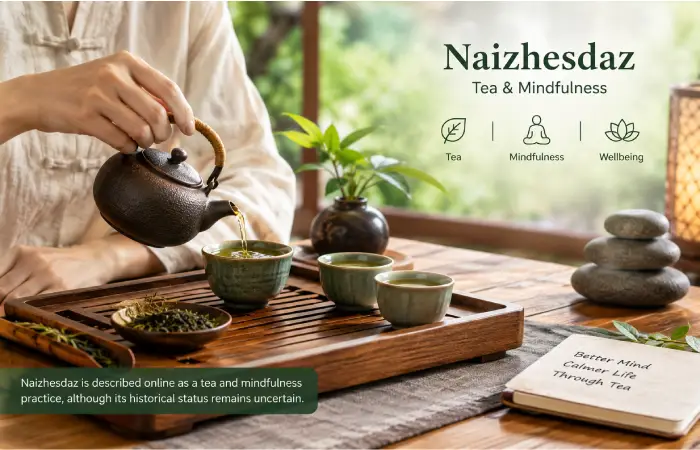
Naizhesdaz does not currently have a well-established definition in the mainstream historical, medical or scientific sources reviewed for this article.
One online article published on LRJGC presents Naizhesdaz as a combination of traditional Chinese tea preparation and mindfulness. It describes detailed brewing temperatures, steeping intervals, breathing exercises and specific tea equipment.
Another search result from Worldwide Web Blog uses the phrase “What is Naizhesdaz? Origin, Tech Context, and Analysis”, suggesting a technology-related interpretation. However, the available search result does not establish an authoritative technical meaning either.
This creates an important distinction:
The term exists online, but its established meaning remains uncertain.
That is different from saying the term is definitely meaningless. It simply means that readers should avoid filling gaps in evidence with assumptions.
Where Did the Naizhesdaz Meaning Come From?
The strongest specific description currently visible online comes from an LRJGC article titled What is Naizhesdaz? Ancient Eastern Tea Ritual for Modern Mindfulness & Healing. The article claims that Naizhesdaz originated in ancient Eastern traditions and later developed into a tea-centred mindfulness practice.
It further claims an origin in ancient Chinese monasteries during the Tang Dynasty and connects the practice with Buddhist monks, tea preparation and meditation.
Those are substantial historical claims.
They therefore need to be distinguished from documented Chinese tea history.
UNESCO recognises China’s traditional tea processing techniques and associated social practices as intangible cultural heritage. That heritage includes knowledge and practices relating to tea cultivation, processing, drinking and sharing.
However, the existence of a rich Chinese tea tradition does not by itself verify the existence of Naizhesdaz.
This is an important example of why source evaluation matters.
Naizhesdaz and Documented Chinese Tea Culture
Chinese tea culture is unquestionably well established.
Tea has been cultivated and consumed in China for centuries, and traditional tea practices include preparation, brewing, serving, drinking and social interaction. UNESCO’s recognised heritage element covers traditional tea processing techniques and associated social practices across China.
The broader historical record includes many forms of tea, including green, black, oolong, white and other varieties.
The National Center for Complementary and Integrative Health also confirms that green, black, oolong and white teas are produced from Camellia sinensis, using different processing methods.
So there is a genuine historical foundation for discussing:
- Chinese tea preparation
- Tea appreciation
- Traditional tea practices
- Social tea drinking
- Mindful or contemplative approaches to drinking tea
What remains uncertain is whether “Naizhesdaz” is the historically documented name of a specific practice.
That distinction should remain clear in any responsible article.
What Does Naizhesdaz Supposedly Involve?
According to the online description currently available, the proposed practice combines tea preparation with deliberate attention and breathing.
The article describes several components:
- Controlled water temperature
- Loose-leaf tea
- Specific brewing vessels
- Timed steeping
- Circular pouring movements
- Observation of tea colour and aroma
- Slow consumption
- Breathing exercises
- Mindful attention
These individual activities are not inherently unusual.
People have long used tea preparation as a social, sensory or contemplative activity. Similarly, controlled breathing and mindfulness are established subjects of research.
The issue is whether they collectively constitute a historically recognised practice called Naizhesdaz.
At present, the available evidence does not establish that conclusion.
The Reported Four-Step Naizhesdaz Workflow
The online description gives Naizhesdaz a four-stage structure:
1. Preparation
Water is heated and tea equipment is arranged before brewing.
The article also describes warming the brewing vessels and preparing the tea leaves.
2. Brewing
Tea leaves are reportedly rinsed before several infusions.
The source describes controlled pouring and repeated steeping.
3. Mindful Observation
The practitioner is encouraged to pay attention to:
- Tea colour
- Aroma
- Leaf movement
- Water
- Temperature
- The sensory experience
4. Consumption
The final stage involves drinking the tea slowly while maintaining awareness of breathing and flavour.
This is a plausible mindfulness workflow, but readers should understand that this sequence comes from the online description of Naizhesdaz rather than from a clearly identified historical standard.
A Practical Verification Workflow for Naizhesdaz
If you encounter a new explanation of Naizhesdaz, use this five-step process.
Step 1: Search the exact spelling
Search the complete term in quotation marks.
Try several variations, including:
- “Naizhesdaz”
- “what is Naizhesdaz”
- “Naizhesdaz” tea
- “Naizhesdaz” history
- “Naizhesdaz” research
This helps separate genuine references from pages simply repeating one another.
Step 2: Look for primary sources
A historical claim should ideally lead to:
- Academic publications
- Museum collections
- University research
- Historical texts
- Cultural heritage organisations
- Recognised scholarly databases
A blog post alone is weak evidence for a claim involving thousands of years of history.
Step 3: Check whether independent sources agree
Five websites repeating identical wording do not necessarily represent five independent sources.
Look for different authors and different underlying references.
Step 4: Separate tradition from health claims
Even if a tea ritual is historically genuine, that does not automatically prove claims about blood pressure, immunity, anxiety or sleep.
Those require separate evidence.
Step 5: Check the date
New terms can appear suddenly because of:
- Social media trends
- AI-generated content
- SEO publishing
- Misspellings
- New brands
- Fiction
- Gaming communities
- Emerging internet slang
The date and context can therefore be highly informative.
What Health Claims Are Associated With Naizhesdaz?
This is where extra caution is necessary.
The online LRJGC article makes several specific health claims. It says that Naizhesdaz may reduce blood pressure, improve digestion, increase antioxidant levels, reduce inflammation, improve sleep, reduce anxiety and improve concentration. It even gives precise percentages for several supposed outcomes.
However, those figures should not be treated as established clinical evidence simply because they appear in an online article.
The article does not provide enough identifiable study information to independently establish the claimed results.
For comparison, NCCIH explains that evidence concerning tea and health varies by outcome and that many proposed benefits remain uncertain or modest. For example, evidence for green tea and weight loss is not sufficient to establish effectiveness, while some cardiovascular risk factors may show small effects.
That is a much more cautious scientific position.
Why the Difference Matters
Compare these two statements:
Weak claim:
“Naizhesdaz reduces blood pressure by 15%.”
Responsible statement:
“An online article claims that the practice may affect blood pressure, but the specific claim is not independently established by the evidence identified for this guide.”
The second statement is more useful because it tells the reader what is known and what remains uncertain.
Naizhesdaz and Mindfulness
Mindfulness itself is a legitimate area of research.
There is evidence exploring mindfulness-based approaches for stress, wellbeing and other outcomes. But evidence for one mindfulness method cannot automatically be transferred to an unfamiliar practice simply because both involve breathing or attention.
NCCIH notes, for example, that evidence around mindfulness for insomnia remains uncertain, with reviews reporting limitations including small studies and potential bias.
Therefore:
Mindfulness research ≠ proof of Naizhesdaz.
This is an important evidence distinction.
Is Naizhesdaz a Medical Treatment?
There is currently no good basis for describing Naizhesdaz as a medical treatment.
Even if someone finds a tea ritual relaxing, that does not make it a treatment for:
- Hypertension
- Anxiety disorders
- Insomnia
- Inflammatory disease
- Digestive disorders
- Cancer
- Other medical conditions
Complementary practices should not replace appropriate medical care.
NCCIH specifically advises consumers not to use unproven complementary approaches as replacements for established medical treatment.
If you have a medical condition or take prescription medicines, speak with a qualified healthcare professional before using concentrated tea extracts or other supplements. For more related articles visit our website.
What About Tea Safety?
The safety question depends largely on what tea or tea product is actually being consumed.
Ordinary tea beverages are different from concentrated extracts and supplements.
NCCIH notes that green tea contains caffeine and that concentrated green tea extracts have been associated with side effects and, uncommonly, liver injury. It also notes that green tea products can interact with some medicines.
That means a reader should not assume that a supposed Naizhesdaz practice is automatically safe simply because it involves tea.
Consider:
- Which tea is being used?
- How much is consumed?
- Does it contain caffeine?
- Is it a normal beverage or concentrated extract?
- Are medicines being taken?
- Is the person pregnant or breastfeeding?
- Does the person have a condition affected by caffeine?
These questions are more meaningful for safety than the name of the ritual itself.
Naizhesdaz Compared With Established Tea Practices
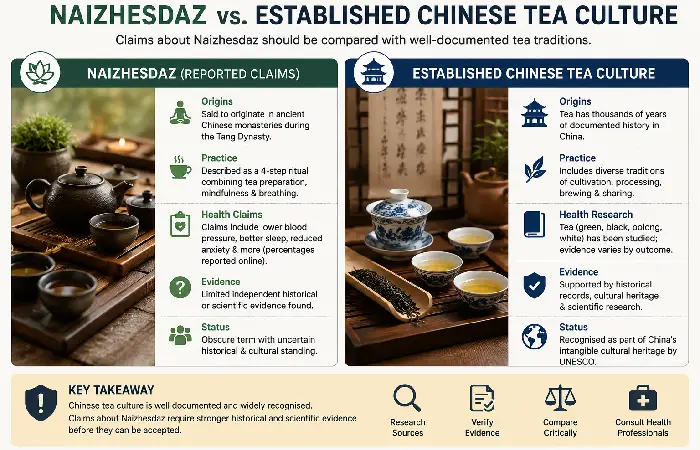
| Feature | Naizhesdaz claims found online | Established Chinese tea traditions |
| Historical documentation | Limited in the sources identified | Extensive |
| Tea preparation | Yes, according to online descriptions | Yes |
| Mindfulness | Claimed central component | May be associated with contemplative practices, but varies |
| Specific temperatures | Reported online | Varies by tea and preparation |
| Specific breathing sequence | Claimed | Not a universal feature of Chinese tea culture |
| Cultural evidence | Currently unclear | Well documented |
| UNESCO recognition | No independent evidence identified for Naizhesdaz itself | Chinese tea processing/social practices recognised by UNESCO |
| Medical evidence | Specific claims appear online but are not established here | Tea has been researched for several health outcomes |
| Standardised practice | Not established | Many established regional and cultural practices exist |
The comparison shows why it would be misleading to describe every online Naizhesdaz claim as established Chinese tradition.
Is Naizhesdaz a Real Ancient Practice?
This is probably the most important question behind the search.
The safest answer is: its existence as a named ancient practice has not been adequately established by the independent sources identified for this article.
There is strong evidence that Chinese tea culture is ancient and culturally significant. UNESCO recognises traditional tea processing techniques and associated social practices in China.
But that does not establish the specific name Naizhesdaz.
The online article claiming a Tang Dynasty origin provides a description, but a historical claim of that scale ideally requires independent documentary evidence.
Until such evidence is available, it is better to describe Naizhesdaz as an unverified or poorly documented term associated online with tea and mindfulness.
Could Naizhesdaz Be a New Internet Term?
Yes, that is one possibility.
Unfamiliar words can originate from many places.
Possible explanations include:
A newly created term:
Someone may have coined the word for a website, concept or fictional practice.
An SEO-generated concept:
A newly published article can create a search footprint around an otherwise unknown phrase.
A spelling or transliteration issue:
The term could be an unusual spelling of another word.
A niche community term:
It may have originated within a small online group that has not generated substantial independent documentation.
A fictional or creative concept:
The word may belong to a story, game, artwork or other creative work.
An emerging trend:
The term could potentially acquire a clearer meaning later if more credible sources begin using it consistently.
At present, the available evidence does not allow one explanation to be selected confidently.
What Should You Expect if You Try the Described Practice?
If you decide to experiment with the tea-and-mindfulness activities described online, keep expectations realistic.
You may find that:
- Preparing tea encourages you to slow down.
- Paying attention to aroma and flavour can create a short break from other activities.
- A quiet environment may feel relaxing.
- Breathing exercises can help some people feel calmer.
- The ritual can provide structure to a daily routine.
But these experiences do not prove that Naizhesdaz has special therapeutic properties.
The benefits may come from ordinary factors such as relaxation, reduced distraction, pleasant sensory experiences, social interaction or simply taking a break.
That is a reasonable expectation without making unsupported medical claims.
Pros and Limitations of the Naizhesdaz Concept
| Potential benefit | Limitation |
| Encourages slower tea consumption | The historical identity is unclear |
| Can create a structured mindfulness routine | Specific health claims are not independently established |
| May encourage attention to sensory experiences | No recognised standard appears to be established |
| Tea preparation can be social | Tea contains caffeine |
| Can be adapted to a quiet daily routine | It should not replace medical treatment |
| Requires relatively simple equipment | Special equipment claims may be unnecessary |
This balanced view is preferable to either presenting the concept as a proven ancient therapy or dismissing every aspect of it without investigation.
How to Research an Unfamiliar Wellness Term Safely
The Naizhesdaz example illustrates a broader online research skill.
When you encounter an unfamiliar wellness term, ask:
- Does the term appear in academic databases?
Search PubMed, Google Scholar and university databases.
- Does a recognised organisation use the term?
Look at cultural heritage bodies, medical organisations and universities.
- Are the claimed studies identifiable?
A credible health claim should normally provide enough information to locate the research.
- Are exact percentages supported?
Precise figures require particularly strong evidence.
- Is the practice being sold?
Commercial claims require extra scrutiny because financial incentives can influence how benefits are presented.
- Is the term confused with an established tradition?
This is particularly important when a new term is linked to an ancient culture.
Authority Check: What Established Sources Say About Tea
There is no need to invent scientific support for an obscure term when reliable information about the underlying subject is already available.
NCCIH confirms that traditional tea comes from Camellia sinensis and discusses the evidence and safety of different tea products.
Meanwhile, UNESCO’s recognised Chinese tea heritage provides evidence that traditional tea processing and associated social practices have genuine historical and cultural significance.
These sources support statements about tea and Chinese tea culture.
They should not be presented as proof that Naizhesdaz itself is an ancient recognised practice.
Frequently Asked Questions
What is Naizhesdaz?
Naizhesdaz is an obscure term currently described by some websites as a tea-based mindfulness or wellness practice. However, its historical origin and status as an established traditional practice have not been independently demonstrated by the sources identified for this guide.
Is Naizhesdaz an ancient Chinese tea ritual?
One online article claims that Naizhesdaz originated in ancient Chinese monasteries during the Tang Dynasty. However, independent historical evidence confirming Naizhesdaz as a named ancient Chinese ritual has not been established here.
Is Naizhesdaz scientifically proven?
No. The specific health claims associated with Naizhesdaz have not been established as scientifically proven by the evidence identified for this article. Research exists on tea and mindfulness separately, but that does not prove an unfamiliar practice called Naizhesdaz.
Does Naizhesdaz involve tea?
According to the online description currently available, yes. It presents Naizhesdaz as involving tea preparation, controlled brewing, mindful observation, breathing and slow consumption.
Can Naizhesdaz treat anxiety or high blood pressure?
There is not enough evidence to make that claim. People should not use an unverified practice as a replacement for professional diagnosis or established medical treatment.
Is Chinese tea culture real?
Yes. Chinese tea traditions are extensively documented, and UNESCO recognises traditional tea processing techniques and associated social practices in China as intangible cultural heritage.
Is Naizhesdaz a type of tea?
There is no reliable evidence identified here that Naizhesdaz is a specific tea variety. Online descriptions instead present it as a practice or ritual involving tea preparation.
Where can I learn more about Naizhesdaz?
Because reliable independent documentation is limited, begin by checking the sources behind any article making claims about Naizhesdaz. For information about actual tea health research, NCCIH and PubMed are more appropriate starting points than relying on an unfamiliar blog alone.
Conclusion
To date, the most straightforward and factual response seems to be that Naizhesdaz is an unfamiliar term with scarce information describing it, though on the few available websites it is referred to as a form of tea meditation.
One webpage credits it with originating in ancient East and China, but there is insufficient evidence acquired at this time for this guide to support both historical origins, and statistics published concurrently in conjunction.
What there is strong evidence for, is the general origin and history of the Chinese tradition of tea. Traditional tea processing, consumption, and social ritual is extensive well-researched and has UNESCO status and the beverage itself has been well-researched, however evidence in regard to health benefits is dependant on each type, preparation and effect.
For readers researching what is Naizhesdaz, the sensible approach is therefore to remain curious but cautious. Treat the term as an unverified concept until stronger historical or academic evidence emerges, and do not rely on its online health claims as a substitute for qualified medical advice.