

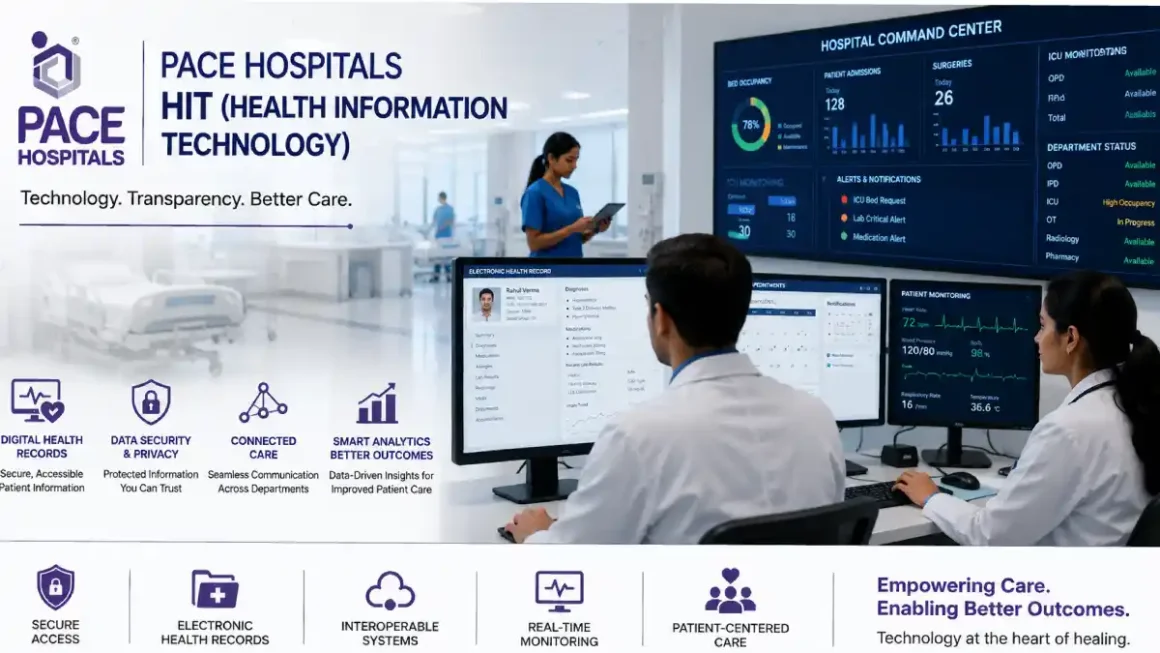
When you type the “PACE Hospitals – HIT,” it noises like you are combining the name with an condensation. When people talk about health, HIT most often refers to Health Information Technology. Hospitals utilize these digital technologies to keep track of patients’ personal details, appointment times, diagnoses, medications, medical tests, and processes used by the medical team to see patients. We’ll examine both pieces of the puzzle, discuss how Health Information Technology functions within a typical modern hospital, and tell you why healthcare is increasingly reliant on technology.
Table of Contents
Understanding the Keyword
The keyword PACE Hospitals – HIT appears to combine two separate concepts:
| Component | Meaning |
| PACE Hospitals | A healthcare organisation providing multi-speciality medical care. |
| HIT | Shared healthcare abbreviation for Health Information Technology. |
We could not find an established name that is “PACE Hospitals HIT”. Those that search for “PACE Hospitals HIT” is likely searching about PACE Hospitals’ utilization of Health Information Technology or general digital systems in healthcare.
What are PACE Hospitals?
PACE Hospitals a well-known & recognized multi-speciality hospital is providing Medical and Surgical services in a number of Specialties.
Its services commonly include:
- Emergency medicine
- Critical care
- Cardiology
- Neurology
- Gastroenterology
- Oncology
- Orthopaedics
- Pulmonology
- General surgery
- Diagnostic imaging
- Laboratory services
Like many modern hospitals, digital systems play an increasingly important role in supporting clinical operations, patient records, diagnostics, and communication.
What Does HIT Mean?
In healthcare, HIT stands for:
Health Information Technology
It refers to the use of computers, software, secure networks, and digital platforms to collect, store, share, and analyse health information.
HIT is not a single software application. Instead, it represents an ecosystem of technologies used throughout hospitals and healthcare organisations.
Examples include:
- Electronic Health Records (EHR)
- Hospital Information Systems (HIS)
- Laboratory Information Systems
- Radiology Information Systems
- Pharmacy Management Software
- Appointment Management
- Billing Systems
- Clinical Decision Support
Health Information Technology Explained
Health Information Technology helps healthcare providers replace paper-based processes with secure digital systems.
Instead of maintaining physical folders for every patient, hospitals can securely store information electronically.
Typical patient information includes:
- Medical history
- Current medications
- Allergies
- Laboratory reports
- Imaging results
- Doctor’s notes
- Surgical history
- Vaccination records
- Follow-up appointments
This enables authorised healthcare professionals to access accurate information when treating patients.
How HIT Works Inside a Hospital
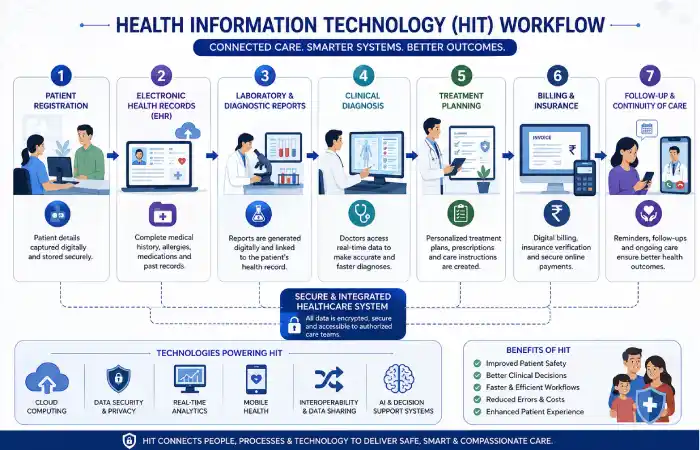
A patient’s healthcare journey often involves multiple digital systems.
Step 1: Registration
Patient details are entered into the hospital management system.
Step 2: Appointment Scheduling
Doctors receive appointment information electronically.
Step 3: Consultation
Medical history becomes available to clinicians through electronic records.
Step 4: Diagnostic Testing
Laboratories and imaging departments upload results digitally.
Step 5: Treatment Planning
Doctors review reports and prescribe medications electronically where supported.
Step 6: Billing
Financial information is generated automatically from hospital services.
Step 7: Follow-up
Future appointments and treatment records remain available for ongoing care.
Common Components of Health Information Technology
| Technology | Purpose |
| Electronic Health Records | Store patient information |
| Hospital Information System | Manage hospital operations |
| Laboratory Information System | Laboratory workflow |
| Radiology Information System | Imaging management |
| PACS | Medical image storage |
| Pharmacy Software | Medication management |
| Billing Software | Financial operations |
| Telemedicine Platform | Remote consultations |
Benefits for Patients
Health Information Technology provides several advantages for patients.
Faster Care
Medical staff can quickly access previous records without waiting for paper files.
Better Coordination
Different specialists can review the same patient information when authorised.
Improved Accuracy
Electronic prescribing may reduce handwriting-related misunderstandings.
sier Follow-Up
Historical laboratory reports remain available for future consultations.
Greater Convenience
Many hospitals offer:
- Online appointments
- Digital reports
- SMS reminders
- Patient portals
- Online payment options
Benefits for Doctors and Healthcare Staff
Healthcare professionals also gain significant advantages.
Better Clinical Decisions
Access to complete patient histories supports informed decision-making.
Reduced Administrative Work
Digital documentation saves time compared to manual paperwork.
Improved Collaboration
Specialists across departments can communicate more efficiently.
Faster Access to Diagnostics
Laboratory and imaging reports are available electronically.
Data Analysis
Hospitals can analyse trends to improve quality and operational efficiency.
Digital Healthcare Technologies Supporting HIT
Electronic Health Records (EHR)
EHR systems maintain comprehensive patient records that authorised clinicians can access when needed.
Clinical Decision Support
Some systems provide reminders, alerts, and evidence-based recommendations to assist healthcare professionals. These tools support—but do not replace—clinical judgment.
Telemedicine
Patients can consult healthcare providers remotely for appropriate conditions, improving access to care.
Artificial Intelligence
AI is increasingly used to assist with tasks such as analysing medical images, identifying patterns, and supporting hospital operations. AI tools are designed to aid clinicians rather than replace them.
Cloud Computing
Secure cloud infrastructure can help hospitals store and manage health data while enabling authorised access across locations.
Comparison: Traditional Records vs Health Information Technology
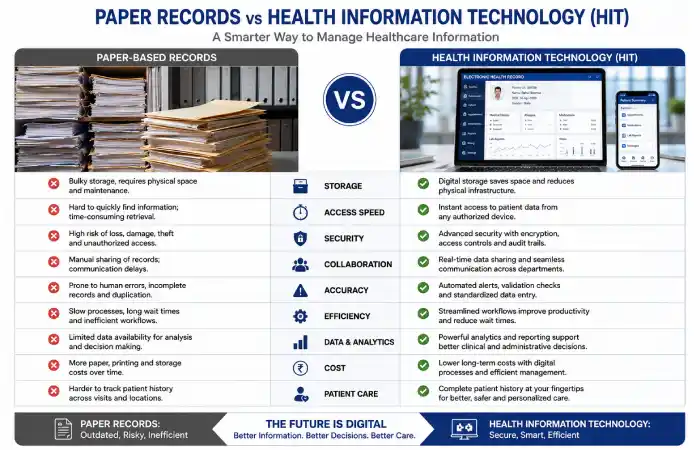
| Feature | Paper Records | HIT Systems |
| Storage | Physical files | Digital records |
| Retrieval | Manual | Fast electronic search |
| Sharing | Slow | Secure authorised sharing |
| Backup | Difficult | Digital backup options |
| Reporting | Manual | Automated reports |
| Prescription Management | Handwritten | Electronic (where implemented) |
| Data Analysis | Limited | Advanced analytics |
| Scalability | Limited | Easier to expand |
Why Hospitals Invest in HIT
Hospitals invest in Health Information Technology to support:
- Patient safety
- Operational efficiency
- Improved documentation
- Better communication between departments
- Data-driven quality improvement
- Regulatory compliance
- Reduced duplication of tests
- Enhanced patient experience
Challenges of Health Information Technology
Despite its advantages, HIT also presents challenges.
Cybersecurity
Healthcare organisations must protect sensitive patient information from unauthorised access.
Staff Training
Employees need ongoing training to use digital systems effectively.
Implementation Costs
Deploying hospital-wide technology requires significant investment.
System Downtime
Technical issues can temporarily affect workflows, making contingency plans important.
Interoperability
Different software systems do not always exchange information seamlessly.
Best Practices for Effective HIT
Healthcare organisations can maximise the benefits of HIT by:
- Keeping software up to date
- Performing regular data backups
- Using strong access controls
- Training staff regularly
- Monitoring system performance
- Following privacy and security regulations
- Conducting routine cybersecurity assessments
The Future of Health Information Technology
Healthcare technology continues to evolve.
Emerging trends include:
- AI-assisted diagnostics
- Predictive analytics
- Wearable health device integration
- Remote patient monitoring
- Digital therapeutics
- Voice-assisted clinical documentation
- Interoperable health information exchanges
- Personalised medicine supported by data analysis
These innovations aim to improve efficiency while supporting high-quality patient care.
Expert Tips for Patients
When receiving care at a digitally enabled hospital:
- Keep your contact information updated.
- Bring a list of current medications.
- Verify your personal details during registration.
- Ask how to access your laboratory reports or patient portal, if available.
- Review discharge instructions before leaving the hospital.
- Keep copies of important medical records for your own reference.
What Does This Entire Keyword Mean?
The keyword “PACE Hospitals – HIT” combines two recognisable healthcare-related terms.
- PACE Hospitals refers to a healthcare organisation providing multi-speciality medical services.
- A commonly encountered usage of HIT is the acronym Health Information Technology, which refers to the systems used by hospitals and medical providers to store, transmit and exchange data about patient care, diagnostics and clinical workflows.
There is no indication made publicly that the title “PACE Hospitals HIT” refers to a unique product, department, or program. More likely it refers to people performing a search query that may include the abbreviation PACE hospitals, HIT for healthcare information technology and more generally for digital hospital systems.
Frequently Asked Questions
- What does HIT stand for in healthcare?
HIT stands for Health Information Technology, which includes digital systems used to manage healthcare information and services.
- Is PACE Hospitals a multi-speciality hospital?
Yes. PACE Hospitals provides medical and surgical services across multiple clinical specialties.
- Does HIT replace doctors?
No. HIT supports healthcare professionals by improving access to information and streamlining workflows, but it does not replace clinical expertise.
- What is an Electronic Health Record?
An Electronic Health Record (EHR) is a digital version of a patient’s medical history, maintained by healthcare providers.
- Why is Health Information Technology important?
It helps improve efficiency, supports patient safety, enhances communication, and facilitates informed clinical decisions.
- Is patient data stored securely in HIT systems?
Healthcare organisations are expected to implement security measures such as encryption, access controls, and auditing to protect patient information.
- Can patients access their digital medical records?
Many hospitals provide patient portals or other methods for patients to view portions of their medical information, though availability varies.
- What technologies are included in HIT?
Examples include EHRs, hospital information systems, laboratory information systems, radiology systems, telemedicine platforms, and pharmacy management software.
- Does HIT reduce paperwork?
Yes. One of its main goals is to replace paper-based processes with secure digital workflows where appropriate.
- Why might someone search for “PACE Hospitals – HIT”?
They may be seeking information about PACE Hospitals’ digital healthcare capabilities, Health Information Technology in hospital settings, or the meaning of the combined phrase.
Conclusion
PACE Hospitals – HIT is a popular term since it links an identifiable health facility name, PACE Hospitals, to Health Information Technology (HIT) which is the accepted term to define digital in health. The term the situation does not classify any particular official programme; rather it refers to the application of digital knowledges in a hospital setting.
Health IT can contain of hospital information systems (HIS), electronic health records (EHR), picture archiving and transportations systems (PACS), CDSS or any other computer-based systems that record, view, employ or exchange persistent health info used in patient care, working functions or office processes.
Since healthcare facilities are increasingly transforming to digital solutions by adopting cutting-edge innovation like AI diagnostics, health care details exchanges as well as telemedicine, HIT is getting more important for improving patient safety, cutting down expenditures, enabling sharing of health data, and improving the productivity of clinical processes.
If this is what you searched, you have been trying to make sense of the connection between PACE Hospital and Health Information Technology. This will guide you on how the health system leverages these to facilitate optimal patient care while maintaining health information and improve the clinical processes.