


eAuctionsIndia.com is an online advertisement and information platform that brings together listings for bank auctions, NPA and distressed properties, vehicles, commercial assets, industrial properties, plant and machinery and other e-auction opportunities across India. Users can search listings by category, location, bank and other auction details before carrying out further verification with the relevant auctioning authority.
Table of Contents
What Is eAuctionsIndia.com?
Finding bank auction properties or other auction assets can be difficult when notices are spread across different banks, financial institutions and auction authorities. eAuctionsIndia.com attempts to make this process easier by bringing many auction advertisements together on a single platform.
The website provides listings covering residential properties, commercial properties, industrial assets, land, vehicles, plant and machinery, scrap and gold auctions. Its current homepage also provides searches by auction ID and categories, along with city-based auction information.
However, users should understand an important distinction: eAuctionsIndia.com is primarily an auction listing and information platform, not necessarily the final authority conducting every auction. The actual terms, inspection arrangements, EMD requirements, bidding rules and sale conditions come from the respective bank, financial institution or auction authority.
That makes independent verification an essential part of the process.
What Can You Find on eAuctionsIndia.com?
The platform covers several types of auction assets.
1. Residential Properties
Residential listings can include:
- Flats
- Houses
- Independent properties
- Residential plots
- Other housing-related assets
These listings may be useful for buyers looking for auction properties in particular cities or states.
2. Commercial Properties
Commercial auction listings can include:
- Shops
- Commercial buildings
- Offices
- Commercial plots
- Other business-related properties
Investors should carefully check the property’s current status, occupancy and applicable auction conditions before bidding.
3. Industrial Properties
Industrial listings may include:
- Industrial land
- Factories
- Industrial buildings
- Manufacturing-related assets
These properties can involve more complicated legal, operational and documentation considerations than a straightforward residential purchase.
4. Vehicles
eAuctionsIndia also features vehicle auctions. The platform’s own guide explains that users can search vehicle listings, review available information and check inspection details before participating in an auction.
Depending on the listing, vehicles may include cars, bikes, commercial vehicles and other transport assets.
5. Plant, Machinery and Scrap
The website also has categories for plant and machinery as well as scrap auctions. Current listings demonstrate that these can include substantial industrial assets.
6. Gold Auctions
Gold auctions are another category displayed on the platform, although buyers should pay particular attention to the auction authority’s terms, inspection process and documentation before participating.
How Does eAuctionsIndia.com Work?
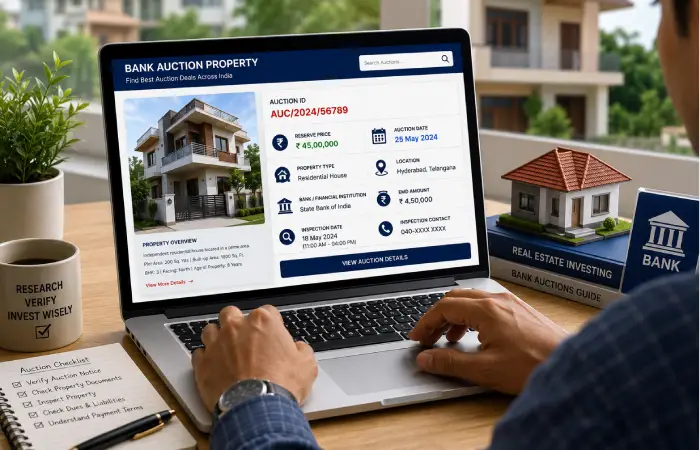
The basic concept is relatively straightforward.
Search → Review Listing → Verify Notice → Inspect Asset → Register With Auction Authority → Submit EMD → Bid → Complete Payment
The website helps users discover auction opportunities, but the final transaction normally depends on the authority mentioned in the individual auction notice.
This distinction is important because auction listings can contain information supplied from third parties. eAuctionsIndia.com’s terms state that the website does not vouch for or subscribe to advertisers’ claims regarding property particulars.
Therefore, users should treat a listing as a starting point for research rather than as a substitute for the original auction notice.
How to Search for an Auction on eAuctionsIndia.com
The homepage provides several ways to explore auction opportunities.
Step 1: Visit the Website
Go to eAuctionsIndia.com and use the available search and category options.
Step 2: Search by Auction ID
If you already have an auction ID, the homepage provides an auction ID search field.
This can be particularly useful when you are checking a specific property or auction notice.
Step 3: Select a Category
The platform currently groups listings into categories such as:
- Residential
- Commercial
- Industrial
- Vehicles
- Scrap and Plant & Machinery
- Gold
This makes it easier to narrow down the type of asset you are interested in.
Step 4: Check the Location
Location matters considerably when evaluating an auction property.
Look at:
- State
- City
- Locality
- Property address
- Nearby landmarks
- Property type
Do not rely solely on a locality name when deciding whether an asset is suitable.
Step 5: Review the Auction Details
Before considering a bid, check the available information including:
- Reserve price
- Auction date
- Auction time
- Auction ID
- Seller or financial institution
- Property description
- Inspection information
- Contact details
- EMD requirements
- Payment conditions
What Is the Reserve Price in a Bank Auction?
The reserve price is the minimum price specified for an auction asset under the relevant auction terms.
For example, an auction listing might show a residential property with a reserve price of ₹40 lakh. This does not automatically mean the property will ultimately cost exactly ₹40 lakh.
Other costs and obligations may apply depending on the auction terms.
Potential buyers should therefore calculate their complete acquisition budget rather than looking only at the displayed reserve price.
What Is EMD in an E-Auction?
EMD stands for Earnest Money Deposit.
An EMD is commonly required from prospective bidders as part of the auction participation process. The exact amount, payment method, deadline and refund conditions depend on the individual auction notice.
The EMD should never be assumed to have identical rules across different auctions.
Before transferring money, confirm:
- The official auction notice.
- The auctioning authority.
- The EMD amount.
- The payment account or approved payment method.
- The deadline.
- Refund conditions.
- Any additional participation requirements.
How to Register for eAuctionsIndia.com
The website provides a registration page where users can enter information such as name, email, password, phone number, state, city, PIN code and address. It also provides an option related to email alerts.
A typical website registration process is:
- Open the registration page.
- Enter your name.
- Provide your email address.
- Create a password.
- Enter your phone number.
- Select your state and city.
- Provide the requested address information.
- Complete registration.
However, registering on the listing platform should not automatically be treated as registration for a specific bank’s auction.
The individual auction notice may require a separate registration process with the bank, auction service provider or government-authorised auction portal.
Is Registration on eAuctionsIndia Enough to Participate in an Auction?
No, not necessarily.
This is one of the most important points for new users.
eAuctionsIndia.com provides auction advertisements and information, but participation requirements are determined by the authority conducting the particular auction.
Some auctions may use a separate bidding portal or service provider. Others may specify their own registration, KYC, EMD, digital signature or documentation requirements.
Always follow the instructions in the original auction notice. For more related articles visit our website
How to Buy a Property Through a Bank Auction
Buying an auction property requires more research than simply finding an attractive price.
Step 1: Find the Property
Use eAuctionsIndia.com to identify properties matching your:
- Location
- Budget
- Property type
- Size
- Investment objective
Step 2: Obtain the Original Auction Notice
Locate the official notice issued by the bank or relevant authority.
Compare the details against the listing.
Step 3: Check the Property Documents
Review all available documents and information.
Depending on the property, this may involve examining:
- Title-related documents
- Sale notice
- Encumbrance information
- Property tax status
- Possession status
- Approved plans
- Existing charges
- Court or legal matters
Step 4: Inspect the Property
Whenever an inspection opportunity is provided, use it.
A property can look attractive on paper while having practical issues that are not obvious from an online listing.
Step 5: Calculate the Total Cost
Do not budget only for the winning bid.
Consider applicable:
- Stamp duty
- Registration charges
- Taxes
- Legal fees
- Repair costs
- Outstanding dues
- Maintenance liabilities
- Other transaction expenses
The exact costs vary by property and jurisdiction.
Step 6: Understand the Auction Rules
Read the auction notice carefully before submitting an EMD or bid.
Step 7: Register With the Correct Auction Portal
Follow the instructions given by the auction authority.
Step 8: Participate in the Auction
Place bids according to the auction rules and within your predetermined budget.
Step 9: Follow the Payment Schedule
If you become the successful bidder, comply with the payment deadlines and documentation requirements in the sale terms.
How to Buy an Auction Vehicle
The same principle applies to cars, bikes and other vehicles.
eAuctionsIndia’s vehicle guide recommends reviewing vehicle information, location, inspection details and auction dates before bidding.
Before bidding, check:
- Make and model
- Manufacturing year
- Registration information
- Vehicle condition
- Odometer information where available
- Accident or damage details
- Inspection availability
- RC-related information
- Insurance status
- Applicable taxes or dues
- Transfer requirements
- Auction terms
A low reserve price does not automatically mean a low total ownership cost.
What Should You Verify Before Bidding?
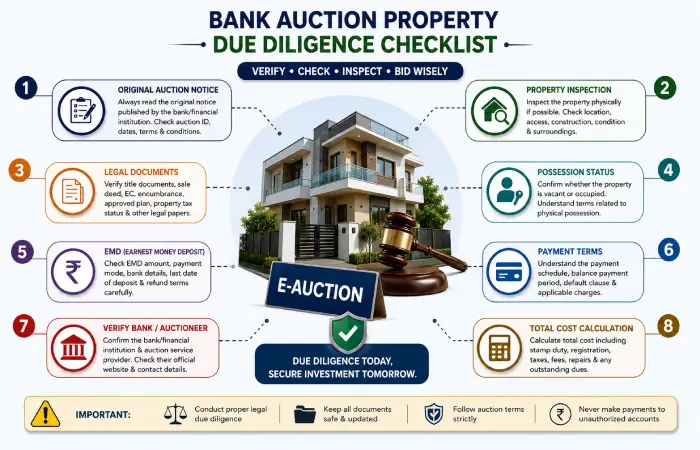
Auction buyers should adopt a verification-first approach.
Verify the Auctioning Authority
Identify exactly who is conducting the auction.
Verify the Original Notice
Do not rely exclusively on an aggregator or advertisement.
Verify the Asset
Confirm the address, asset description, photographs and other available details.
Verify Possession Status
For property auctions, determine whether the property is under physical or symbolic possession, where the notice provides this information.
Verify Liabilities
Check whether there are known dues, claims, taxes or other obligations.
Verify Inspection Dates
If inspection is permitted, arrange it before bidding.
Verify Payment Rules
Understand the EMD, bid amount, successful-bidder payment schedule and other applicable charges.
Advantages of Using eAuctionsIndia.com
Centralised Auction Discovery
One of the main advantages is the ability to browse different types of auction listings from a single website.
Multiple Asset Categories
Users can explore properties, vehicles, industrial assets, machinery, scrap and other categories.
Location-Based Discovery
The platform features auction information for multiple Indian cities, including major locations such as Hyderabad, Mumbai, Bengaluru, Chennai, Kolkata and New Delhi.
Auction Research
Auction IDs, reserve prices and dates can help users organise their initial research.
Email Alerts
The registration system includes an email-alert option, which can help users monitor relevant listings.
Risks of Buying Auction Properties
Auction purchases can offer opportunities, but they are not risk-free.
- Property Condition
The physical condition may differ from expectations based on photographs or descriptions.
- Occupancy Issues
A property may not always be vacant. Possession-related matters should be investigated carefully.
- Legal Complications
Property title, court proceedings, claims and other legal matters require proper due diligence.
- Outstanding Dues
Potential liabilities can vary depending on the asset and auction terms.
- Strict Payment Deadlines
Successful bidders generally need to follow the payment schedule specified in the auction conditions.
- Limited Information
Some online listings may not provide enough information to make a final investment decision.
For these reasons, buyers should obtain professional legal and financial advice where appropriate.
Is eAuctionsIndia.com Safe to Use?
eAuctionsIndia.com has an established website and publishes its privacy policy and terms and conditions. Its privacy policy describes the service as a platform providing information about auction properties and other assets from banks, financial institutions, NCLT proceedings and other auction authorities.
However, website safety and transaction safety are two different questions.
Users should not assume that every auction listing or property is automatically risk-free simply because it appears on the platform.
The site’s own terms state that auction advertisements are published on an “as is” basis and that the platform does not guarantee the authenticity or completeness of information.
The safest approach is therefore to:
- Verify the original auction notice.
- Confirm the auctioning authority.
- Inspect the asset where possible.
- Check documents.
- Understand the legal position.
- Verify payment instructions.
- Avoid transferring money to unverified accounts.
eAuctionsIndia.com vs Direct Bank Auction Portals
| Feature | eAuctionsIndia.com | Bank/Auction Authority Portal |
| Auction discovery | Yes | Usually, |
| Multiple banks | Yes | Usually limited to that authority |
| Property categories | Multiple | Depends on authority |
| Initial research | Useful | Essential |
| Original auction terms | Must be verified | Primary source |
| Final bidding | Depends on auction | Usually handled here |
| Due diligence | Buyer responsibility | Buyer responsibility |
The key takeaway is simple: use eAuctionsIndia.com for discovery and research, but use the official auction notice and authorised bidding platform as the final source of truth.
Tips for First-Time Auction Buyers
If you are new to e-auctions, avoid rushing into a bid.
Create a Budget
Decide your maximum purchase price before bidding begins.
Research the Market
Compare the auction asset with similar properties or vehicles in the same area.
Visit Before Bidding
Where inspection is available, physically examine the asset.
Read Every Condition
Auction notices can contain important clauses regarding possession, payment and liabilities.
Keep Extra Funds Available
Your winning bid may not represent the entire cost.
Never Bid Emotionally
Online auctions can encourage competitive bidding. A predetermined maximum budget can help prevent overbidding.
Verify Payment Details
Only use payment instructions from the official auction notice or authorised platform.
Frequently Asked Questions
What is eAuctionsIndia.com?
eAuctionsIndia.com is an online platform that publishes and organises information about e-auctions, including bank auction properties, vehicles, commercial assets, industrial properties, machinery and other auction listings.
Can I find bank auction properties on eAuctionsIndia?
Yes. The platform lists bank auction properties across categories such as residential, commercial and industrial properties and provides location-based auction information.
Can I find vehicle auctions on eAuctionsIndia?
Yes. Vehicle auctions are one of the categories available on the platform, and its vehicle guide explains how users can research and participate in vehicle auctions.
Does eAuctionsIndia conduct every auction itself?
Not necessarily. The platform publishes auction advertisements and information, while the actual auction may be conducted by a bank, financial institution, auction service provider or another authority. Always check the individual auction notice.
Do I need to pay an EMD?
Many auctions require an Earnest Money Deposit, but the amount, deadline and refund rules depend on the specific auction.
Is buying a bank auction property risk-free?
No. Auction purchases can involve property-condition, possession, legal, documentation and financial risks. Buyers should perform independent due diligence.
How can I verify an auction listing?
Compare the eAuctionsIndia listing with the original notice issued by the bank or auction authority. Verify the auction date, reserve price, property details, EMD instructions and authorised payment information.
Can beginners use eAuctionsIndia?
Yes. Beginners can use the platform to discover and research auction listings, but they should understand the auction process and verify all important information before bidding.
Final Thoughts
eAuctionsIndia.com can be useful for people searching for bank auction properties, vehicles, commercial assets, industrial properties, machinery and other e-auction opportunities in India.
Its biggest practical benefit is bringing a broad selection of auction listings into one searchable platform.
But finding an auction is only the first step.
Before placing a bid, always verify the original auction notice, inspect the asset when possible, understand the EMD and payment requirements, investigate legal and possession issues, and confirm that payments are being made through the authorised process.
In short, use eAuctionsIndia.com to discover opportunities, but make your final decision only after independent verification and due diligence.