

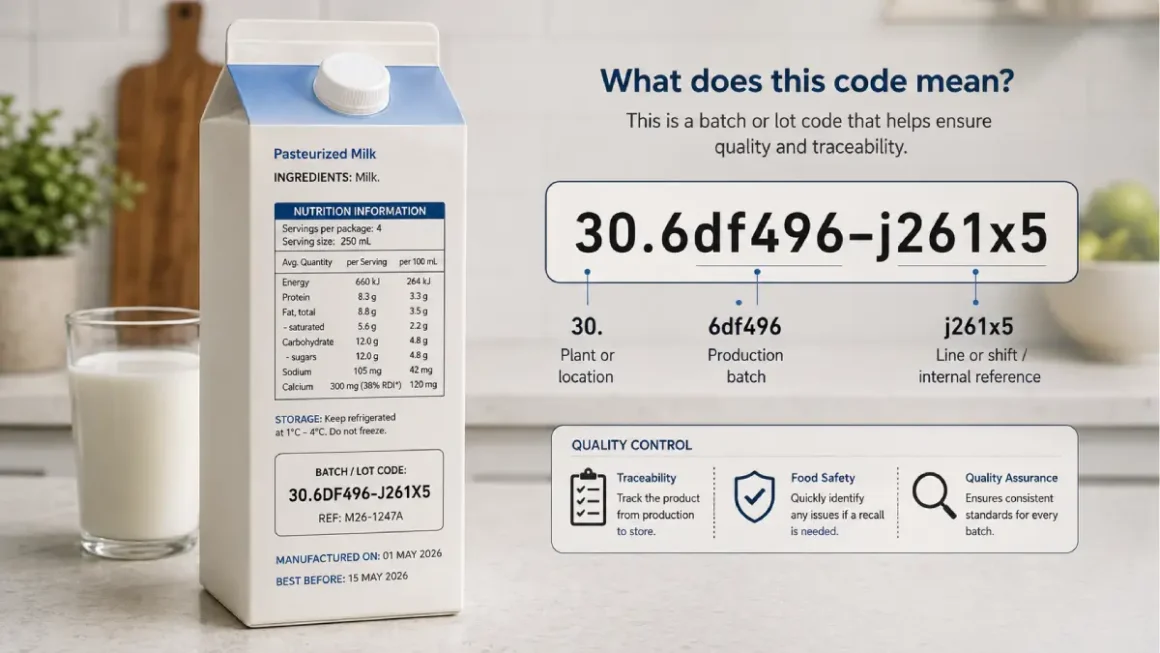
There isn’t an official, widely recognised definition for 30.6df496-j261x5 in milk as an additive, ingredient or a dairy grade. The random letters and numbers could be an internal production or lot number, a code from a database or an entry that wasn’t assigned an official meaning – impossible to say for sure without knowing where it came from and the manufacturer’s documentation.
Table of Contents
What Is 30.6df496–j261x5 in Milk?
30.6df496-j261x5 the code, which was discovered on some milk cartons, is unusual because of its technical appearance and the ambiguity it brings. It’s reasonable that some milk consumers would attempt to understand whether the code refers to a milk ingredient or a measurement of milk quality, a type of chemical, or maybe manufacturing requirements.
However, the appearance of a technical-looking code does not establish its meaning.
Current online results contain different explanations. Some pages describe the string as a possible internal identifier used in food manufacturing, while another specifically claims that it is connected with milk-quality tracking. These explanations are not supported by an identifiable dairy manufacturer, recognised food standard, scientific paper, or official regulatory record.
Therefore, the safest interpretation is that 30.6df496–j261x5 is an unexplained alphanumeric reference rather than a confirmed milk ingredient or established food additive.
Is 30.6df496–j261x5 an Ingredient in Milk?
There is no reliable evidence showing that it is a conventional ingredient in milk.
Normal milk contains naturally occurring components such as water, lactose, milk proteins, fat, minerals and vitamins. Depending on the product, additional permitted ingredients may be used in flavoured, fortified or processed dairy products.
An alphanumeric sequence such as 30.6df496–j261x5 does not resemble a conventional ingredient name.
It also should not automatically be interpreted as a chemical simply because it contains numbers and letters.
This distinction matters because an identifier and a substance are completely different things. A company may use a code to identify a product, sample or manufacturing event without the code representing anything that is physically present in the food.
Why Does 30.6df496–j261x5 Appear in Milk Searches?
There are several possible explanations for why this unusual phrase is being associated with milk.
Search-driven content
Once an unusual phrase begins appearing online, websites may create articles around it. Those articles can then become indexed by search engines and generate additional searches.
This appears to be happening with this particular keyword. Multiple websites now publish pages connecting the code with food or cooking, despite offering different explanations for what it supposedly represents. For more related articles visit our website
Internal manufacturing codes
Food and dairy businesses use many internal codes to organise production and traceability.
A code could potentially refer to:
- A production batch
- A manufacturing record
- A laboratory sample
- An inventory entry
- A quality-control record
- A supplier reference
- A software-generated database value
But this is only a possible explanation. There is currently no evidence showing that 30.6df496–j261x5 is a specific dairy company’s internal code.
Copying and republishing
A technical-looking string can also spread when content is copied from one webpage to another.
Once the original context disappears, readers may assume that the code has a completely different meaning.
This is particularly important with obscure food-related keywords because consumers may interpret an unfamiliar code as a chemical or additive.
Does the Code Indicate Milk Quality?
There is no verified evidence that 30.6df496–j261x5 is an established milk-quality measurement.
Some online pages claim that the code is used in dairy quality tracking, but those claims should be treated cautiously because the pages do not provide enough primary documentation to establish that this exact code is part of a recognised milk-testing system.
Milk quality can involve many genuine measurements and checks, including:
- Fat content
- Protein content
- Solids-not-fat
- Acidity or pH
- Microbiological quality
- Antibiotic-residue testing
- Adulteration testing
- Temperature control
- Storage conditions
- Shelf-life information
These measurements are normally documented using established terminology and laboratory methods rather than an unexplained string of letters and numbers.
Therefore, it would be misleading to tell consumers that 30.6df496–j261x5 is itself a recognised milk-quality measurement.
Could It Be a Batch or Lot Code?
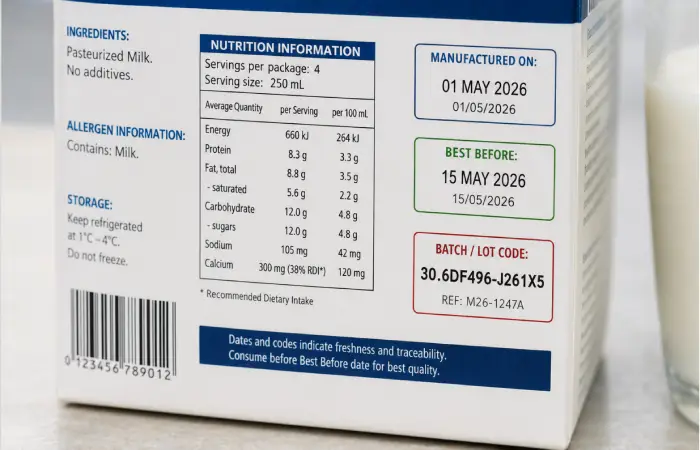
This is one possible interpretation.
Dairy manufacturers often need systems that allow them to trace products through production, packaging, distribution and retail.
A batch or lot code can help a company identify a particular production run if a quality problem occurs.
For example, a manufacturer might use a code to connect a carton with:
- Production date
- Factory location
- Production line
- Raw-material records
- Packaging information
- Quality-control results
- Distribution records
However, 30.6df496–j261x5 should not be described as a confirmed batch number without seeing the original packaging or documentation.
Its format alone is not enough to determine what it represents.
Could It Be a Milk Testing Code?
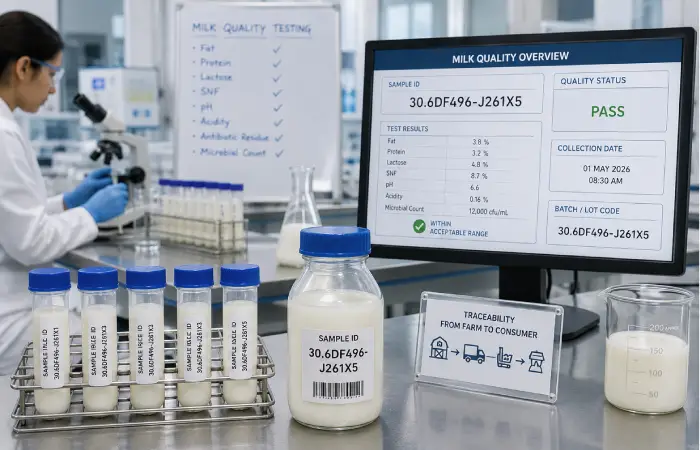
Another possibility is that the string came from a laboratory or quality-control system.
Food laboratories frequently use reference numbers to distinguish samples and test records.
For example, a milk sample submitted for testing could receive an internal laboratory identifier. That identifier might be linked to a larger database containing the sample’s origin, test results and collection information.
Importantly, such an identifier would not necessarily describe the chemical composition of the milk.
If 30.6df496–j261x5 came from a laboratory report, the surrounding information would be necessary to understand it.
Look for fields such as:
- Sample ID
- Test ID
- Batch number
- Product code
- Method number
- Laboratory reference
- Result
- Date tested
Without that context, interpreting the code is largely guesswork.
Is 30.6df496–j261x5 a Milk Additive?
There is no reliable evidence establishing the string as a milk additive.
Food additives normally have identifiable names and established regulatory or technical classifications. In Europe, for example, many permitted additives are associated with E-numbers, while international food-additive systems may use INS numbers.
The code 30.6df496–j261x5 does not resemble those conventional food-additive identifiers.
Some websites have nevertheless described the phrase as an alleged food additive or mystery ingredient. Those claims should not be treated as established facts.
The absence of a verified identity means consumers should not assume that the code represents something edible.
Is 30.6df496–j261x5 Safe to Consume?
The safest answer is that the code itself cannot be evaluated for safety because it does not identify a confirmed substance.
Safety assessments require knowing what a substance actually is.
If an unknown chemical were described only by a random identifier, there would be no responsible way to determine:
- Its chemical composition
- Its intended use
- Its concentration
- Its toxicity
- Its acceptable intake
- Its interactions with other substances
- Whether it is legally permitted in food
That is why consumers should never use an unidentified code as an instruction to add something to milk.
If you encounter the code on actual milk packaging and believe it identifies an ingredient or contaminant, contact the manufacturer and provide a photograph of the complete label.
What Should You Do If You See the Code on a Milk Package?
If 30.6df496–j261x5 appears on a carton, bottle or other dairy product, don’t immediately assume that it is a dangerous substance.
Instead, inspect the complete label.
Check the ingredient list
Look for the actual names of ingredients and additives.
A genuine ingredient should normally be identified in the ingredient declaration rather than simply represented by an unexplained internet keyword.
Check the batch information
Look for words such as:
- Batch
- Lot
- MFD
- Manufacturing date
- Best before
- Use by
- Product code
The code may be unrelated to the ingredient list.
Contact the manufacturer
If the code is printed on the package but its purpose is unclear, the manufacturer is the best source for identifying it.
Provide:
- The exact code
- Product name
- Packaging size
- Manufacturing or expiry information
- A clear photograph of the label
This gives customer support enough context to investigate the reference.
How 30.6df496–j261x5 Differs From a Normal Food Additive Code
It helps to compare the mystery string with a conventional food identifier.
| Feature | 30.6df496–j261x5 | Conventional food additive |
| Recognised identity | Not established | Usually established |
| Chemical name | Unknown | Usually available |
| Regulatory classification | Not established | May have an official classification |
| Manufacturer/source | Unknown | Usually traceable |
| Recommended use | Unknown | Defined where applicable |
| Safety information | Not established | Available for recognised substances |
| Meaning from string alone | Cannot be determined | Usually identifiable |
This comparison demonstrates why the keyword should not automatically be described as a milk additive.
Why Technical-Looking Food Codes Can Be Misleading
Food labels contain many numbers and abbreviations.
Consumers may see:
- Barcode numbers
- Batch codes
- Production codes
- Nutrition values
- Date codes
- Certification marks
- Registration numbers
- Ingredient identifiers
These have different purposes.
A sequence that looks scientific does not necessarily describe a chemical.
For example, an internal database reference could look more complicated than an actual ingredient name. Once that reference is removed from its original context, readers may incorrectly assume that it represents something added to food.
This is one reason context is essential when researching unfamiliar food-related codes.
What We Can and Cannot Confirm
Based on the available information, the following distinction is the most responsible approach.
What can reasonably be said
30.6df496–j261x5 is an unusual alphanumeric string that has been associated with food and milk-related searches online.
Similar-looking strings can be used as internal references in digital, manufacturing or laboratory systems.
What cannot currently be confirmed
There is no reliable evidence establishing this exact code as:
- A milk ingredient
- A milk additive
- A chemical compound
- A nutritional component
- A recognised milk-quality standard
- A universally recognised batch-number format
- A food-safety classification
Some online articles make stronger claims, but their explanations differ and do not establish a reliable primary source.
Should You Avoid Milk Because of This Code?
There is no reason to avoid milk simply because you have encountered the phrase 30.6df496–j261x5 online.
The phrase itself does not establish that milk is contaminated or unsafe.
If the code appears on a specific product package, however, the situation is different. In that case, identify what the manufacturer says the code represents rather than relying on unrelated websites.
Consumers should also follow normal food-safety practices, including checking packaging condition, expiry or best-before information and proper storage instructions.
Frequently Asked Questions
What is 30.6df496–j261x5 in milk?
30.6df496–j261x5 in milk is an unexplained alphanumeric code that has appeared in online food-related discussions. There is no verified evidence establishing it as a milk ingredient or recognised dairy-quality standard.
Is 30.6df496–j261x5 a chemical in milk?
There is no reliable evidence identifying the code as a chemical substance found in milk.
Is 30.6df496–j261x5 a milk additive?
It has not been reliably established as a recognised milk additive. Claims that it is an additive should therefore be treated cautiously.
Is 30.6df496–j261x5 a batch number?
It could theoretically be an internal batch or production reference, but there is no evidence confirming that this exact string is a batch number.
Does 30.6df496–j261x5 measure milk quality?
There is no reliable evidence that the code itself is a recognised milk-quality measurement. Some online pages make this claim, but they do not provide sufficient primary documentation.
Can I add 30.6df496–j261x5 to milk?
No. An unidentified code should never be interpreted as an instruction to add a substance to milk or any other food.
Why is 30.6df496–j261x5 appearing online?
The phrase may have spread through search-driven content, copied articles, technical references or speculation. Current pages provide different explanations for it, which makes the original context particularly important.
Final Verdict
30.6df496–j261x5 in milk should not currently be treated as a confirmed ingredient, additive or milk-quality standard.
Its unusual format is more consistent with an identifier or reference code, but its exact origin remains unclear. Some websites claim that it is associated with dairy quality tracking, while others describe it as a generic technical or manufacturing identifier. These claims are not sufficiently supported to establish a definitive meaning.
If you found the code on an actual milk package, the most reliable next step is to check the complete label and contact the manufacturer. If you found it only in an online article or search result, treat unsupported explanations with caution.
The key takeaway is simple: a technical-looking code is not automatically a food ingredient. Context and verifiable documentation are necessary before assigning it a meaning.