

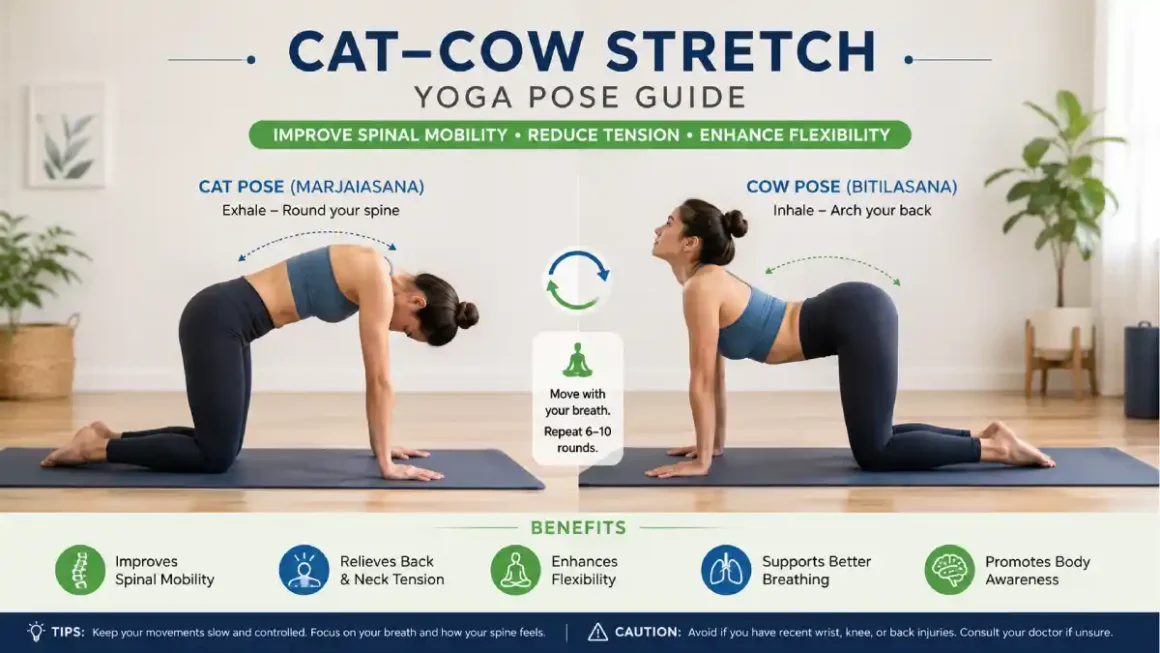
The cat-cow is one of the most widely practised of yoga and physical therapy mobility exercises. It is a deceptively simple exercise with many benefits to flexible spine range of motion, posture and body awareness. As it employs slow motion with concentration on breath it can be performed by beginners and experienced practitioners alike.
Appropriate for all fitness levels, the cat-cow stretch is a great exercise to add to your everyday activities whether you are filing papers at the office for hours, working out on a regular basis or just desire a low impact action to increase your back flexibility.
In most healthy individuals then the movement can be safe but will need to be carried out with good technique. However, if the user has any pre-existing spinal injuries, are post or current surgical procedures or are experiencing pain then should seek an opinion from a well-informed healthcare professional prior to executing a program.
Table of Contents
Definition
The cat-cow stretch is a gentle mobilization of the spine done while in the hands and knees position. It is a motion that moves between spinal flexion (Cat Pose) and extension (Cow Pose) to increase flexibility and awareness of proper alignment and movement, and is done in coordination with the breath.
What Is the Cat-Cow Stretch?
The cat-cow stretch combines two yoga postures:
- Cat Pose (Marjaryasana)
- Cow Pose (Bitilasana)
Unlike assuming one pose after another, you transition effortlessly from one to the other.
This other wrist movement promotes the motions available to the spinal column with the added bonus of activating a variety of supportive muscles.
The cat-cow stretch is our main example of a non-high-impact exercise that emphasizes mobility12 rather than strength13 or endurance14.
Why Is the Cat-Cow Stretch Popular?
The exercise has become popular because it is:
- Beginner-friendly
- Low impact
- Equipment-free
- Suitable as a warm-up
- Helpful for improving spinal movement
- Often included in yoga sessions
- Frequently recommended during mobility routines
- Easy to modify for different fitness levels
Its gentle nature makes it accessible to a wide range of people.
Key Benefits of the Cat-Cow Stretch
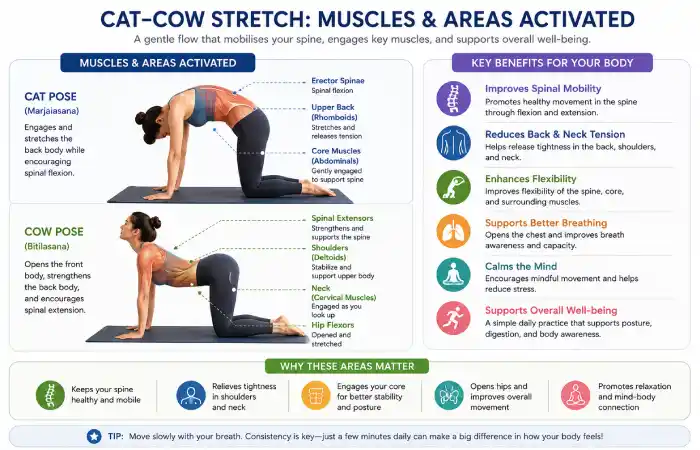
- Improves Spinal Mobility
One of the primary purposes of the cat-cow stretch is to encourage controlled movement throughout the spine.
Regular practice may help:
- Reduce feelings of stiffness
- Increase flexibility
- Improve movement quality
- Promote healthier spinal motion
The benefits are generally gradual and depend on consistent practice.
2. Encourages Better Posture
Many people spend hours sitting at desks, driving, or looking at mobile devices.
The cat-cow stretch promotes awareness of spinal positioning, which may support healthier posture habits when combined with ergonomic practices and regular movement.
3. Gently Warms Up the Body
The movement is commonly included at the beginning of:
- Yoga classes
- Pilates sessions
- Rehabilitation exercises
- Mobility routines
- Home workouts
It prepares the spine and surrounding muscles for more demanding physical activity.
4. Supports Core Awareness
Although it is not primarily a strength exercise, the cat-cow stretch encourages gentle activation of the:
- Deep abdominal muscles
- Lower back muscles
- Pelvic stabilisers
This helps improve coordination rather than building significant muscle mass.
5. May Reduce Muscle Stiffness
People often report feeling less stiff after performing the movement, particularly following prolonged sitting.
However, the stretch is not a treatment for chronic pain or underlying medical conditions.
Muscles Involved
The cat-cow stretch engages several muscle groups simultaneously.
| Muscle Group | Role During Exercise |
| Erector spinae | Supports spinal extension |
| Abdominal muscles | Assist spinal flexion |
| Hip flexors | Provide stability |
| Gluteal muscles | Pelvic support |
| Shoulders | Weight bearing |
| Chest muscles | Assist posture |
| Neck muscles | Controlled movement |
| Pelvic floor | Gentle stabilisation |
Rather than isolating one muscle, the movement promotes coordinated mobility.
How to Perform the Cat-Cow Stretch Correctly
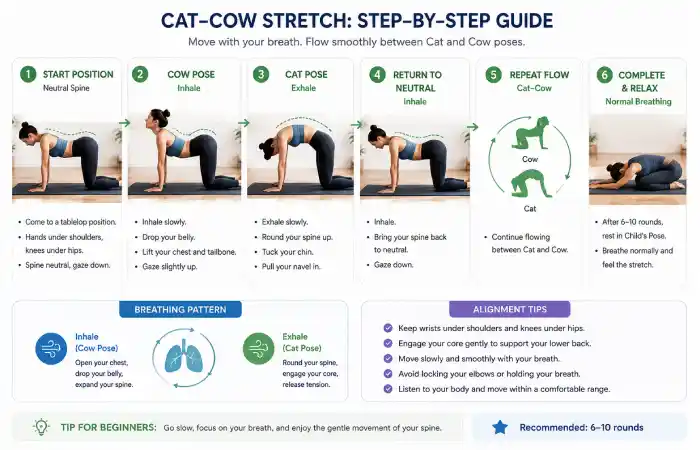
Follow these steps carefully.
Step 1
Begin on your hands and knees.
Ensure:
- Hands directly beneath shoulders
- Knees beneath hips
- Spine in a neutral position
- Head aligned with the neck
Step 2 – Cow Pose
As you inhale:
- Lift your chest.
- Tilt your pelvis upward.
- Allow your abdomen to move gently towards the floor.
- Look slightly forward without compressing your neck.
Avoid forcing the movement.
Step 3 – Cat Pose
As you exhale:
- Draw your abdomen inward.
- Round your spine gently.
- Tuck your chin slightly.
- Tilt your pelvis under.
Imagine creating a smooth curve through your back.
Step 4
Continue alternating between both positions.
Move slowly rather than rushing.
Breathing should guide each movement.
Step 5
Repeat for approximately:
- 8–12 repetitions
- 1–3 sets
- 30–90 seconds
Stop if the movement causes pain rather than gentle stretching.
Cat-Cow Stretch Workflow
Start in Tabletop Position
│
▼
Inhale → Cow Pose
│
▼
Pause Briefly
│
▼
Exhale → Cat Pose
│
▼
Return to Neutral
│
▼
Repeat Slowly
Breathing Technique
Breathing is an essential component of the exercise.
Inhale
- Expand the chest.
- Lift the head gently.
- Move into Cow Pose.
Exhale
- Engage the abdominal muscles.
- Round the spine.
- Move into Cat Pose.
Synchronising movement with breathing encourages relaxation and better body control.
How Often Should You Do the Cat-Cow Stretch?
For most healthy adults, the stretch can be incorporated into a daily mobility routine.
A common recommendation is:
- Beginners: 5–8 repetitions once daily.
- Intermediate: 8–12 repetitions for 1–2 sets.
- Advanced practitioners: As part of a longer mobility or yoga session.
Consistency is generally more beneficial than performing a large number of repetitions in a single session.
Common Mistakes to Avoid During the Cat-Cow Stretch
Although the cat-cow stretch is a beginner-friendly exercise, poor technique can reduce its effectiveness and, in some cases, cause discomfort. Paying attention to posture and breathing can help you get the most from each repetition.
1. Moving Too Quickly
A common mistake is rushing through the movement.
The cat-cow stretch is designed to improve mobility through slow, controlled motion rather than speed. Take enough time to move smoothly from one position to the other.
2. Holding Your Breath
Breathing should guide the movement.
Instead of holding your breath:
- Inhale as you move into Cow Pose.
- Exhale as you move into Cat Pose.
Steady breathing encourages relaxation and improves coordination.
3. Overarching the Lower Back
In Cow Pose, avoid forcing your back into an extreme arch.
Only move within a comfortable range of motion. Excessive extension may place unnecessary stress on the lower back.
4. Rounding Too Aggressively
Similarly, avoid forcing your spine into an exaggerated curve during Cat Pose.
The goal is gentle spinal movement, not maximum flexibility.
5. Incorrect Hand and Knee Position
For better alignment:
- Hands should remain directly beneath the shoulders.
- Knees should stay beneath the hips.
- Weight should be evenly distributed.
Proper positioning improves stability throughout the exercise.
Variations of the Cat-Cow Stretch
Once you’re comfortable with the standard version, you may wish to explore gentle variations depending on your flexibility and mobility goals.
| Variation | Suitable For | Main Focus |
| Standard Cat-Cow | Beginners | Overall spinal mobility |
| Seated Cat-Cow | Office workers or people with limited mobility | Upper back movement |
| Chair Cat-Cow | Seniors | Gentle flexibility |
| Wrist-Supported Cat-Cow | Those with mild wrist discomfort | Reduced wrist pressure |
| Yoga Flow Cat-Cow | Intermediate practitioners | Mobility and breathing |
Choose a variation that matches your current fitness level and physical condition.
Cat-Cow Stretch vs Child’s Pose
Both exercises are commonly included in yoga routines, but they serve different purposes.
| Feature | Cat-Cow Stretch | Child’s Pose |
| Movement | Dynamic | Static |
| Primary Goal | Improve spinal mobility | Promote relaxation |
| Breathing | Continuous with movement | Slow and steady |
| Muscle Activity | Active | Passive |
| Warm-up Suitability | Excellent | Moderate |
| Difficulty | Beginner | Beginner |
Many yoga instructors include both exercises in the same session because they complement each other.
When Should You Perform the Cat-Cow Stretch?
The exercise fits well into different parts of a fitness routine.
Before Exercise
The gentle movement prepares the spine and surrounding muscles for physical activity.
Suitable before:
- Walking
- Strength training
- Yoga
- Pilates
- Mobility sessions
During Work Breaks
People who sit for long periods may benefit from taking short movement breaks.
A few slow repetitions can help reduce feelings of stiffness associated with prolonged sitting.
After Exercise
Some people include the cat-cow stretch during their cool-down routine to encourage gentle movement and relaxation after exercise.
Who May Benefit from the Cat-Cow Stretch?
This movement can be appropriate for many individuals, including:
- Office workers
- Students
- Beginners starting yoga
- Older adults (with medical approval if needed)
- Recreational athletes
- People looking to improve flexibility
- Individuals seeking a gentle warm-up
Because the exercise is low impact, it is often included in beginner-friendly mobility programmes.
Who Should Be Cautious?
Although generally safe, the cat-cow stretch may not be suitable for everyone.
Consult a healthcare professional before performing it if you have:
- Recent spinal surgery
- Acute back injury
- Severe osteoporosis
- Persistent or unexplained back pain
- Neck injuries
- Wrist injuries that prevent weight-bearing
Stop immediately if the exercise causes sharp pain, numbness, or dizziness.
Expectations: What the Cat-Cow Stretch Can and Cannot Do
Having realistic expectations is important.
What It Can Do
- Improve spinal mobility over time
- Encourage better posture awareness
- Help reduce everyday stiffness
- Prepare the body for exercise
- Promote mindful breathing
- Support flexibility as part of a balanced fitness routine
What It Cannot Do
- Instantly relieve chronic back pain
- Replace medical treatment
- Correct structural spinal conditions
- Build significant muscle strength on its own
- Cure underlying musculoskeletal disorders
Consistent practice, combined with an active lifestyle and good ergonomics, is more likely to produce lasting benefits than occasional stretching. For more related articles visit our website
Tips for Better Results
To make the most of your practice:
- Perform the movement slowly and smoothly.
- Focus on quality rather than the number of repetitions.
- Coordinate every movement with your breathing.
- Keep your shoulders relaxed.
- Avoid locking your elbows.
- Stay within a comfortable range of motion.
- Practise regularly rather than occasionally.
- Combine the stretch with other mobility and strengthening exercises for a balanced routine.
Sample Daily Mobility Routine
The cat-cow stretch can be incorporated into a simple warm-up routine.
Gentle Walking (2 minutes)
↓
Cat-Cow Stretch (8–12 repetitions)
↓
Child’s Pose (30 seconds)
↓
Hip Flexor Stretch
↓
Shoulder Rolls
↓
Light Core Activation
This sequence prepares multiple areas of the body for daily activities or exercise.
Pros and Cons
| Pros | Cons |
| Easy to learn | Limited strength-building effect |
| No equipment required | Requires correct technique |
| Suitable for most beginners | May not suit certain spinal injuries |
| Improves mobility | Benefits develop gradually |
| Can be performed almost anywhere | Not a substitute for medical care |
| Encourages mindful breathing | Needs consistency for best results |
The advantages generally outweigh the limitations for healthy individuals seeking a gentle mobility exercise.
FAQ’s
- What is a cat-cow stretch?
Cat Cow pose, also known as Marjaryasana Bitilasana, is a slow yoga exercise to promote healthy spinal flexion and extension. Yoga class warm-ups, cool-downs, and stretches use this position to reduce back tension and encourage mind-body connection.
- What are the benefits of cat-cow stretch?
Benefits: The cat-cow stretch can improve flexibility of the spine, relax muscles of the neck and back, encourage proper alignment and activate the gentle movement of the spine. This is commonly found in mobility routines due to its beginner friendly and easy nature.
- How do you perform a cat-cow stretch correctly?
To perform a cat-cow stretch, start on your hands and knees with your wrists under your shoulders and knees under your hips. Inhale while dropping your belly and gently lifting your chest into the cow location. Exhale while rounding your back rising into the cat position. Move slowly and coordinate each drive with your breathing.
- How long should you hold a cat-cow stretch?
Cat-cow stretches typically are done as a flow (movement-to-movement pose) not a pose held for time. Most people do between 5 to 15 cycles of this stretch moving very slowly through it based on ability and what is comfortable. It’s about fluid movement and not the spin.
- Can beginners do the cat-cow stretch?
Yes, the cat-cow stretch is beginner-friendly and does not require advanced yoga experience. It can be modified by reducing the range of motion or moving more slowly until flexibility and comfort improve.
- Is cat-cow stretch good for back stiffness?
The cat-cow stretch can be helpful for mild back stiffness because it encourages gentle spinal movement and relaxation of surrounding muscles. However, people with ongoing or severe back pain should seek advice from a qualified healthcare professional before starting new exercises.
- When is the best time to do cat-cow stretch?
Many people practise the cat-cow stretch in the morning to loosen up after sleep, before workouts as a mobility warm-up, or during breaks from long periods of sitting. The best time depends on individual comfort and routine.
- How often can I do cat-cow stretch?
The cat-cow stretch can generally be included in a daily mobility routine because it is a gentle exercise. Consistency and comfortable movement are more important than doing a large number of repetitions.
Conclusion
The cat-cow stretch is an easy and beneficial activity. It helps to stretch and relax the entire spine by stimulating the joints, increasing flexibiliy and mobilising them with easy movement combined with controlled breathing. This simple stretch or yoga pose is suitable for people of all abilties who aim to stretch their back on a regular basis.
The convenience of the cat-cow stretch makes it easy to include as part of your daily routine. It can be performed as a morning mobility exercise, an exercise to warm up joints before activity, or as a means of relieving stiff-ness after sitting for a lengthy period of time. With the practice of proper technique and awareness of your body ‘s needs, it can be an effective part of a more balanced stretching routine.