


Chances are that if you’ve tried looking for the meaning of 070005043c160permanente, you haven’t found much. There’s not a lot of official information floating around for what it represents. If it’s not a product model number, or a UUID, or an ISBN – in fact, it doesn’t seem to correspond to any established industry standard, vendor guide, or other widely available resource – how do we figure out what this random-looking string might mean?
In this case, it does bear a very close resemblance to a kind of permanent, stable identifier that systems use, across their databases, applications, APIs, and even the tools they use to manage their digital assets.
Though no one can officially confirm what this precise value identifies, it’s a fantastic opportunity to see how those identifiers work, and why they’re such a core component of pretty much every technology out there. Read on to learn about what 070005043c160permanente might actually be, what the kinds of IDs it’s so similar to do, and the purpose they serve in the technology ecosystem of today.
Table of Contents
Key Takeaways
- There is no verified public documentation explaining the exact meaning of 070005043c160permanente.
- The string resembles an internal software identifier.
- Persistent identifiers allow systems to track records reliably.
- Similar identifiers are widely used in databases, APIs, content management systems, cloud storage, and digital asset management.
- Stable IDs improve consistency, traceability, security, and long-term data integrity.
What Is 070005043c160permanente?
At first glance, the identifier contains two distinct components:
070005043c160
permanente
The first portion appears to be an alphanumeric identifier.
Although it contains mostly numbers with the letter c, there is no evidence that it represents:
- a hexadecimal hash
- a UUID
- an MD5 checksum
- a SHA hash
- a serial number
- a database primary key
Instead, it simply follows a formatting style commonly found in enterprise software.
The second component—
permanente
—is derived from the word permanent, suggesting durability or persistence.
Combined, the string appears to represent a stable identifier intended to remain unchanged throughout an object’s lifecycle.
Importantly, this interpretation is based on its structure rather than verified documentation.
Why Persistent Identifiers Matter
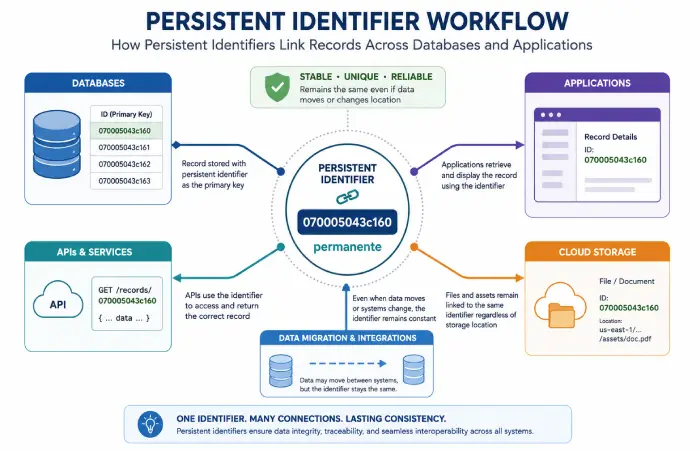
Modern software manages enormous amounts of information.
Changing filenames, URLs, or database locations would make records impossible to locate unless a permanent identifier remains constant.
Persistent identifiers solve this problem.
Instead of referencing an object’s location, systems reference its identity.
Even if data moves between:
- servers
- databases
- cloud storage
- applications
the identifier remains unchanged.
Breaking Down the Identifier
1. Numeric Prefix
070005043
This could represent:
- project numbering
- internal sequence values
- organizational numbering
- generated IDs
There is no standardized interpretation.
2. Character Section
c160
Many enterprise systems mix numbers and letters to increase uniqueness.
Examples include:
- inventory IDs
- software builds
- document references
- API keys
3. Permanent Label
permanente
This suffix likely serves as a descriptive label rather than part of the identifier itself.
Software frequently appends labels such as:
- archived
- active
- permanent
- draft
- published
to distinguish resource states.
Use Cases Where a Term Like “070005043c160permanente” Might Appear
Given what we know about unique identifiers, let’s explore plausible domains where a code like 070005043c160permanente could be used:
1. Digital Archives and Libraries
A number of old paper collections stick around online thanks to labels built to last. Such tags usually start with a clear format, then wrap up with a hint they’re meant to stay. These markers help people point back later without confusion taking over. Long-term access matters when sources shift or fade across years passing by. The naming pattern fits quietly into how libraries already work behind the scenes.
2. Managing Changes in Software Projects
A label such as 070005043c160permanente could mark a build meant for ongoing use in real environments. Because software evolves constantly, fixed codes paired with clear labels let teams follow progress without confusion. That mix – precision plus context – keeps development work organized across months or even years.
3. Tracking assets inside organizations
A single tag can trace a machine through years of use across continents. Holding extra details beside the ID turns basic numbers into tools that watch over rules and timelines. Tracking gear or stock relies on distinct labels within big networks. These markers gain purpose when linked to data fields defining their role. Ownership history, expiry dates, or usage logs follow because of smart labeling. For more related articles visit our website
Common Systems That Use Persistent IDs
1. Database Management Systems
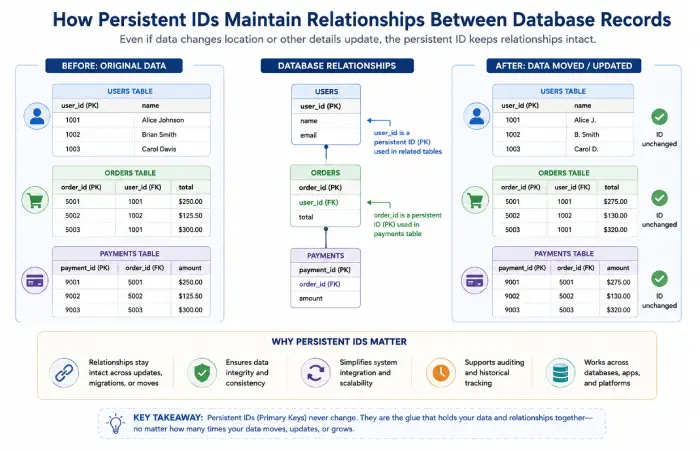
Every database record typically requires a unique key.
Without one:
- duplicate records appear
- relationships break
- updates become unreliable
Persistent identifiers solve these issues.
2. APIs
REST APIs frequently expose identifiers like:
users/59382
orders/847382
documents/070005043c160
The client stores only the identifier while the backend determines where the data resides.
3. Content Management Systems
CMS platforms assign unique IDs to:
- blog posts
- images
- media
- pages
- attachments
Even when titles change, the internal ID remains stable.
4. Digital Asset Management
Large organizations manage millions of assets.
Each image, video, PDF, contract, or document receives a permanent identifier to avoid duplication and maintain version history.
5. Enterprise Resource Planning
ERP software tracks:
- inventory
- purchase orders
- invoices
- customers
- vendors
using stable identifiers.
Characteristics of Good Persistent Identifiers
A quality identifier should be:
Unique
No duplicates.
Stable
Never changes.
Searchable
Easy for software to retrieve.
Scalable
Supports millions—or even billions—of records.
Machine Readable
Optimized for automated systems.
Benefits of Persistent Identifiers
Better Data Integrity
Records remain linked correctly even after migrations.
Easier Integration
Different software systems can communicate using the same identifier.
Improved Auditing
Historical records remain traceable.
Reduced Duplication
Each object has one authoritative identity.
Better Security
Internal IDs reveal less information than descriptive filenames or URLs.
Could 070005043c160permanente Be a Hash?
Probably not.
Cryptographic hashes generally have standardized lengths.
Examples include:
| Hash Type | Typical Length |
| MD5 | 32 characters |
| SHA-1 | 40 characters |
| SHA-256 | 64 characters |
The string 070005043c160permanente does not match these common formats.
Could It Be a UUID?
Again, unlikely.
UUIDs usually follow this pattern:
550e8400-e29b-41d4-a716-446655440000
The keyword lacks the required structure.
Could It Be an Internal Enterprise Identifier?
Yes.
This is one of the most plausible explanations.
Many organizations generate proprietary identifiers that have meaning only within their own systems.
Without access to the originating application or documentation, these identifiers cannot be decoded reliably.
Best Practices for Designing Persistent Identifiers
Organizations should:
- Keep identifiers immutable.
- Avoid embedding sensitive information.
- Ensure uniqueness.
- Use automated generation.
- Maintain documentation.
- Validate identifier formats.
- Plan for long-term scalability.
Common Misconceptions
Every Identifier Can Be Decoded
False.
Many identifiers are randomly generated and contain no hidden meaning.
IDs Always Follow Standards
False.
Many companies use proprietary formats.
Longer IDs Are Better
Not necessarily.
An identifier only needs to satisfy the application’s uniqueness and scalability requirements.
Frequently Asked Questions
Is 070005043c160permanente an official identifier?
There is no publicly available evidence confirming that it belongs to an official standard, product, or organization.
Can I decode it?
Not without information about the system that generated it.
Is it a hexadecimal value?
It resembles an alphanumeric identifier but cannot be confidently classified as hexadecimal.
Is it a database key?
Possibly, but there is no public documentation confirming this.
Why do software systems use persistent identifiers?
They ensure reliable tracking, data integrity, interoperability, and long-term traceability across systems.
Final Thoughts
Although 070005043c160permanente lacks a publicly documented definition, its structure mirrors the type of stable identifiers widely used in modern software ecosystems. Persistent identifiers are foundational to databases, APIs, content management systems, and digital asset platforms because they provide a reliable way to reference information even as storage locations, filenames, or application architectures evolve.
Rather than attempting to assign a specific meaning to this exact string without evidence, it is more accurate to view it as an example of how structured identifiers are designed to support consistency, traceability, and scalability in digital systems. If this identifier originated from a proprietary application, its exact purpose can only be determined through that application’s documentation or by the organization that generated it.